Showing posts with label Weight Loss. Show all posts
Wednesday, February 29, 2012
Motivation From Children's Stories
I certainly find motivation and inspiration in the Word of God, but sometimes I'm sitting at my desk or heading somewhere, and a line or theme from a story I enjoyed as a child will pop into my head:
I think I can, I think I can... (The Little Engine That Could by Watty Piper)
Slow and steady wins the race. (The Tortoise and the Hare by Aesop)
Begin at the beginning and go on till you come to the end: then stop. (Alice in Wonderland by Lewis Carroll)
I do not like green eggs and ham, I do not like them Sam I am! (Green Eggs and Ham by Dr. Seuss)
Pay no attention to that man behind the curtain. (The Wonderful Wizard of Oz by Frank Baum)
Christmas won't be Christmas without any presents. (Little Women by Louisa May Alcott
All of the above apply to this year's, "Eat Less, Move More, Write" journey in some way.
On Eating Less (I'm down 10 lbs on the year!)
Watching what--and how much--I eat makes a difference. Especially how much. If I keep below my target calories, I lose weight. Even if it's only half a pound.
I think I can reach my goal of losing 50 lbs. I think I can. But it will definitely be slow and steady. I've tried to many "fast weight loss" programs to consider going that route again. Like Sam I Am, I may have to consider eating some things I'm not particularly fond of, but usually it's because I've never tried them. And I definitely will have to stop eating some things I love, like potato chips and gobs and gobs of peanut butter.
On Moving More (Hampered a bit by a nerve/muscle problem on my left side, but doctor says it's fixable)
Enjoying weekend walks with Hubby, when he's open to walking a little slower and I'm up for all but jogging, due to the difference in our leg lengths. (He's 6'7" and I'm 5'2".)
Back to "I think I can, I think I can..." I do not like exercise, I do not like it (most of the time, at least when I'm thinking about doing it although usually once I start, it feels pretty good and I'm glad I did it), Pat I Am. But it is important to reaching my goal so that little wo-man behind the curtain (inside my head) who tries to convince me not to do it must be ignored.
On Writing (Wrote and submitted one short story and have been working on wip)
Another slow and steady undertaking, for sure. Except there's something to be said for writing fast. Just get the story out, then worry about whether it's any good later. Which definitely will require ignoring the man behind the curtain (again, my head) who worries about whether the writing is good enough, the story is good enough, pretty much everything and whether it's good enough.
So I begin and go until I can't go anymore, then I stop. Only to begin again. Sometimes in short spurts, sometimes in long sessions. The important thing is to write.
And regarding all three, the celebration I'm looking forward to at the end of this year won't be quite the same if I don't gift myself with the effort it takes to reach my goals. Way too early in the year to anticipate anything other than the present of success.
Do you recall any lines from favorite children's stories? Where do you find motivation for the journey?
Thursday, February 2, 2012
Making My Way Down the Weight Loss Mountain
Downhill is far easier than uphill. If weight loss efforts get too hard, mentally, that is, they're doomed.
Goal weight is a steep mountain, to be sure, but absolutely one I can get down. Can't run or I'll trip and fall, but if I take careful steps, before I know it, I'll reach my goal to get to goal weight.
Given that, since the beginning of the year, I'd say my progress is pretty good. Here's how I've done.
Eat Less: I'm definitely eating less, but consciously so. Using the MyFitnessPal app on my smartphone is the absolute best way to keep track of and be conscious of not only what I eat but more importantly, how much. There's a bit of guesswork when the exact food product isn't in the database, and I eyeball my portion sizes rather than weigh and measure, but I'd still say it's 80-85% accurate. And that's enough to keep me honest. So since my last post, when I was still slightly up after the holidays, I've dropped a net four pounds. "Net" four. From up to down. Just watching what and how much. No special diet plan. Still a little too much snacking but I pay for it by not having enough calories left at the end of the day to have an evening snack without going over my daily allotment. Not bad. Trending in the right direction.
Move More: I began using public transportation to commute to work last month. That alone has me walking more. But Hubby and I have also been going for longer walks on the weekend, like 3 miles or more. Definitely more. Good progress with room for improvement.
Write: Ah, something had to give. Actually, I wrote more in January than I did in December, so that's good. I put my wip aside for a bit to work on a short story, and didn't finish the wip as planned. Also, back to sharing my laptop with my oldest who has a slew of papers he's working on. Still, have to push myself to get back into a daily writing routine. Not beating myself up, but definitely can and have to do better.
How's your progress against your goals going? If you're with me on this weight loss journey, how's it going? Do you view it as climbing up or coming down the mountain?
Peace & Blessings,
Patricia
Friday, January 13, 2012
There Are No Shortcuts
There really aren't any shortcuts to losing weight and getting healthy.
We all would much prefer a "magic bullet" to the hard work and discipline required to get in shape.
I would, but I haven't found one.
Oh, I've tried and had limited success with a number of different types of what I will call diet aids--Jenny Craig, Nutrisystem, Weight Watchers, Atkins, low carb, low fat, protein shakes, HCG--but nothing lasting.
Because if it isn't about real change, it isn't sustainable.
So here I am again, down somewhat from where I was before, but not nearly where I should or want to be after so many years of toiling in this struggle.
I think I'm finally accepting that getting to an ideal weight for my height and age, and staying there, requires significant, monumental changes.
I've begun tracking everything I eat using a cool app that my husband introduced me to, MyFitnessPal. Every morsel.
What I like about this one over other weight loss journaling tools I've used in the past is that it's at my fingertips via my phone; most foods, even brand names, are already in the app so I don't have to guess; and it tells me what my caloric intake should be in a day, another thing that has pretty much been guesswork.
No more guessing. Guesswork = poor results.
The things that I eat that are pretty healthy, like one egg for breakfast, a half cup of fruit salad, an apple, salad, even chili, have pretty reasonable calorie counts. The things I know I shouldn't eat, like Cheez-its, cookies, potato chips, have pretty enormous calories, even in tiny servings. Of course, I knew that, but seeing the actual numbers is a huge wake-up call.
I can tell you it is totally possible to eat twice as much as one should in a given day without feeling completely fat and greedy.
Totally.
Those not-so-great calories really add up.
What will it take for change to become permanent?
I'm doing laundry last night and I'm thinking, as I whisper a prayer, then congratulate myself for bypassing the hard candy, that I've never really trusted God with my weight loss struggle.
Why not?
Then, I read an article in the paper this morning about Baltimore Ravens linebacker Ray Lewis and his incredible discipline for healthy living. He regularly admonishes his family, especially his mother. Lewis says, "I stay mad at my mom because she spends so much time with God but doesn't trust God with her body."
Incoming dart. Right between the eyes.
I would hate for my boys to feel this way. They could say this to me now, as Lewis did about his mother, and they would be right.
When he had gone indoors, the blind men came to him, and he asked them, "Do you believe that I am able to do this?”
“Yes, Lord,” they replied.Then he touched their eyes and said, “According to your faith let it be done to you”; and their sight was restored. -- Matthew 9:28-30
Little faith, little success.
Great faith, great success.
I trust God for many things, but somehow not for this.
Why?
I don't have an answer for that one. I'll be pondering it for a while.
Methinks there are no shortcuts to faith either.
Do you trust--truly trust--God with your chronic struggles? If you (we) did, would the struggle be chronic or would the struggle be over?
~~~~~~~~~~~~~~~~~~~~~~
Eat Less: Overall, not so great, but heading in the right direction. Becoming conscious of everything I'm putting in my mouth.
Move More: Sometimes life works with you when it seems like it's working against you. A little car trouble, resulting in the use of public transportation, goes a long way toward moving more. Walking daily.
Write: This is my other focus area, the one that contributes to my mental and emotional health. Made some progress on the daily writing front, not as much as I would like, but definitely trending in the right direction.
Thursday, January 5, 2012
Renewal of Mind = Body Transformation
Who is "they"?
Friends, family, co-workers, neighbors...could be anyone.
Sometimes, it feels like things are to be shared only after they have come into fruition. But faith is not that way. We have to believe--and share--the things we cannot see so that when they do come into fruition, God will be glorified.
I feel that way about a lot of things, one of which is my weight loss. Feels like I've been sharing and making progress, not so obviously evident progress, for years. Some may wonder why I bother or at least why I keep talking about it.
Because, with God's help, I'm going to make my goal weight.
This year.
I've got a little extra motivation this year, but I'll keep that to myself. For now.
Sure, I've talked a lot here about my weight struggles. Seems like I'm constantly hitting a snag, gaining more than losing and restarting with a newfound zeal.
Truth is, in the past five years, I've lost weight. I began this new year lighter than I have in a long time.
Not where I want to be. Not even close.
But encouraged.
Even with the four lbs I gained over the holidays (the least I can ever remember gaining during this time of the year).
So I'm not restarting because that would mean I'd have to go back to where I was before.
I'm recommitting.
Not a New Year's resolution. I actually started working on this before Thanksgiving which is how I managed to gain so little. (I'm usually good for 10+ lbs.)
More like a renewal of the mind.
Romans 12:2 says "Do not conform any longer to the pattern of this world, but be transformed by the renewing of your mind. Then you will be able to test and approve what God's will is--his good, pleasing and perfect will." (NIV, 1984)
Renewing the mind brings about transformation.
I'm going to transform this body.
This year.
And I'm going with the completely simple, fool-proof method: eat less, move more.
This, believe it or not, has worked well for many, including myself, in the past.
Oh there's more, including the types of foods I choose, how often I eat, and in what quantities, but this simple phrase--"eat less, move more"--succinctly summarizes the plan. It rings in my head which makes it easier to follow.
Anybody with me?
Thursday, February 17, 2011
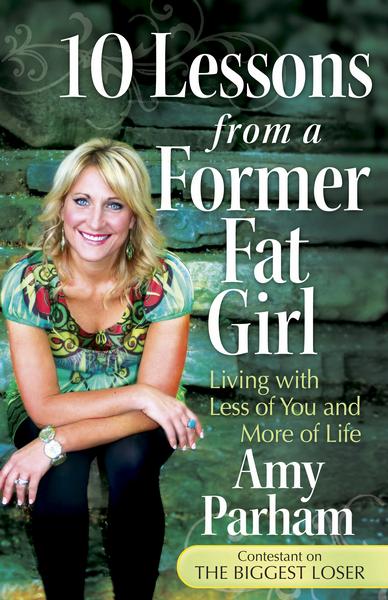
10 Lessons from a Former Fat Girl
I wish!
I wish I were the former fat girl who wrote this book. I'm not, but Amy Parham, former Biggest Loser contestant, is.
BTW, I love The Biggest Loser. Haven't caught the last couple of seasons, but I like what they do. They help people to change their lives. Sure, the contestants get isolated, dedicated time to work on their nutrition, exercise and emotional needs, but it works. And even if some gain their weight right back, not all do. One person saved from death by obesity is a person saved. I've secretly wished I had a life that would allow me to be whisked away for 6-10 weeks and deal with these fat issues once and for all.
I'll get there. I've got two years to meet my goal before my next big milestone.
Anyway, Amy Parham, who participated along with her husband, Chuck, has written a book about what she has learned. 10 Lessons From a Former Fat Girl covers Amy's unvarnished battle with weight and the issues that led to it, as well as how she has managed to lose and maintain her weight loss since.
She says, right in the first chapter, "Often weight can be a security blanket to keep from having to deal with sensitive things going on in the heart, and uncovering those hurts can be a painful process."
Boy, I've found this to be true, at least at the start, when we're not conscious of gaining weight or what we're doing to our bodies. A lot of the issues begin in childhood, where even if your family life was good and nurturing, insecurity may have latched on as you wondered who you were, where you fit and what you were meant to do with your life. Later on, when perhaps the issues are so deeply rooted or maybe even after they've been dealt with, you're stuck with poor eating habits and sedentary lives that require a mountain of effort to get out from under. Through her book, Amy shows that achieving weight loss can be done and words of encouragement to get you through.
ABOUT THE AUTHOR:

Amy Parham co-authored with her husband, Phil, The 90-Day Fitness Challenge and The 90-Day Fitness Challenge DVD. She and Phil were contestants on Season 6 of NBC’s The Biggest Loser. Over a seven-month period, they recorded the highest percentage of weight loss of any couple in the program’s history. Married for more than 20 years, they live in South Carolina with their three boys, Austin, Pearson, and Rhett.
Visit the author's website.
Former fat girl Amy Parham offers a practical, proven plan for changing not only the fat-girl body but also the fat-girl mentality. Focusing on the mental ,emotional, and spiritual aspects of our relationship with food and exercise, Amy shows how readers can make this a healthy partnership that brings permanent change.
Product Details:
List Price: $11.99
Paperback: 192 pages
Publisher: Harvest House Publishers (January 1, 2011)
Language: English
ISBN-10: 0736938656
ISBN-13: 978-0736938655
AND NOW...THE FIRST CHAPTER:

Peace & Blessings,
Patricia
I wish I were the former fat girl who wrote this book. I'm not, but Amy Parham, former Biggest Loser contestant, is.
BTW, I love The Biggest Loser. Haven't caught the last couple of seasons, but I like what they do. They help people to change their lives. Sure, the contestants get isolated, dedicated time to work on their nutrition, exercise and emotional needs, but it works. And even if some gain their weight right back, not all do. One person saved from death by obesity is a person saved. I've secretly wished I had a life that would allow me to be whisked away for 6-10 weeks and deal with these fat issues once and for all.
I'll get there. I've got two years to meet my goal before my next big milestone.
Anyway, Amy Parham, who participated along with her husband, Chuck, has written a book about what she has learned. 10 Lessons From a Former Fat Girl covers Amy's unvarnished battle with weight and the issues that led to it, as well as how she has managed to lose and maintain her weight loss since.
She says, right in the first chapter, "Often weight can be a security blanket to keep from having to deal with sensitive things going on in the heart, and uncovering those hurts can be a painful process."
Boy, I've found this to be true, at least at the start, when we're not conscious of gaining weight or what we're doing to our bodies. A lot of the issues begin in childhood, where even if your family life was good and nurturing, insecurity may have latched on as you wondered who you were, where you fit and what you were meant to do with your life. Later on, when perhaps the issues are so deeply rooted or maybe even after they've been dealt with, you're stuck with poor eating habits and sedentary lives that require a mountain of effort to get out from under. Through her book, Amy shows that achieving weight loss can be done and words of encouragement to get you through.
and the book:
Harvest House Publishers (January 1, 2011)
Special thanks to Christianne Debysingh, Senior Publicist, Harvest House Publishers for sending me a review copy.ABOUT THE AUTHOR:
Amy Parham co-authored with her husband, Phil, The 90-Day Fitness Challenge and The 90-Day Fitness Challenge DVD. She and Phil were contestants on Season 6 of NBC’s The Biggest Loser. Over a seven-month period, they recorded the highest percentage of weight loss of any couple in the program’s history. Married for more than 20 years, they live in South Carolina with their three boys, Austin, Pearson, and Rhett.
Visit the author's website.
SHORT BOOK DESCRIPTION:
Former fat girl Amy Parham offers a practical, proven plan for changing not only the fat-girl body but also the fat-girl mentality. Focusing on the mental ,emotional, and spiritual aspects of our relationship with food and exercise, Amy shows how readers can make this a healthy partnership that brings permanent change.
Product Details:
List Price: $11.99
Paperback: 192 pages
Publisher: Harvest House Publishers (January 1, 2011)
Language: English
ISBN-10: 0736938656
ISBN-13: 978-0736938655
AND NOW...THE FIRST CHAPTER:

We All Have an Empty Place
We’re all searching for something to fill up what I like to call that big, God-shaped hole in our souls. Some people use alcohol, or sex, or their children, or food, or money, or music, or heroin. A lot of people even use the concept of God itself. I could go on and on. I used to know a girl who used shoes. She had over two-hundred pairs. But it’s all the same thing, really. People, for some stupid reason, think they can escape their sorrows.
— Tiffanie DeBartolo, God-Shaped Hole
My earliest memories were such happy ones. Mom had dinner on the table when Dad came home from work, and my two sisters and I laughed and talked about our day with our parents. It was the best feeling. Everything about our family felt so right and secure. I remember Mom walking me to kindergarten every day at a church around the corner from my house. In that same church parking lot, my dad taught me how to ride a bike without training wheels. He also taught me to fly a kite, and with his help, I won a blue ribbon in a kite-flying competition at my school.
I had my own bedroom with a yellow gingham canopy bed and a playhouse in the backyard. There was also a dogwood tree that I climbed all the time. My best friend, Teresa, lived across the street, and my grandparents lived nearby. Life was good and felt normal, but when I turned eight years old, my seemingly perfect life changed forever.
A Growing Hole
Dad quit his longtime job at a local radio station in South Carolina to pursue a job at another radio station in West Palm Beach, Florida. We had to sell our house immediately and move to what seemed to me to be a different planet. I will never forget the image of Teresa and me standing by the “For Sale” sign in our front yard. We bawled our eyes out and held each other so tight because we knew we might not ever see each other again.
When we got to Florida, the five of us moved into a tiny apartment. There was nothing wrong with the apartment, but I was uncomfortable because I was used to living in a larger space and having a big yard to play in. My sisters and I barely had enough room to squeeze past each other on the way to the bathroom. My new school was huge compared to the one I attended in South Carolina. But the worst thing was that while everyone knew and loved me at my old school, I was now the new girl at school, and I got ridiculed for it. I felt insecure, unsure of myself, and alone. I wanted to go back to my happy, carefree life.
This was the first time I remember being unhappy and having no control over my circumstances. I was deeply sad, and it felt like I had an empty hole in my soul. Thankfully, we only stayed in Florida for one year, but things would never go back to how they were before. I would never regain the sense of normalcy I had so desperately craved.
When we came back to South Carolina, we moved to a different city, and my parents bought a restaurant and ice-cream parlor. It was hard work building a new business, and the stress took a toll on Mom and Dad. They began to fight all the time about money and other issues. It got so bad that they divorced.
When my parental situation turned upside down, I found myself in a world that lacked security and stability. Suddenly, I was being raised by a single mother, and as the oldest daughter at ten years old, there was a lot of pressure on me to help my mom care for my two sisters. She worked very hard (sometimes up to 18 hours a day), and I know she did her best to keep food on the table and clothes on our backs. She usually had no time to tuck us in at night and tell us bedtime stories because she worked such long hours.
My sisters (who were four and six years old) and I spent a lot of time at home alone. As much as we tried to pick up after ourselves, you can imagine how messy three kids can be. I felt terrible when my mother would come home, tired from working so much, and be cranky because the house was such a disaster. I never felt like I could do enough to make Mom happy or fix our broken home life.
Many mornings she had to get to work at the crack of dawn and woke us up at three in the morning to take us to the restaurant. She made us a makeshift bed on the concrete floor in the back room and let us sleep there while she worked. This was not an ideal environment for kids, but she was doing the best she could.
It wasn’t her fault. The problem was me. I felt the hole inside my heart growing bigger and bigger, and I desperately needed something to fill it.
Enter the Banana Split
I remember one particular day when I was playing outside the restaurant and decided to go visit the couple who worked at the dry cleaners next door. The owners were in their late twenties and had no children of their own. They were kind enough to let me hang out with them sometimes, and it made me feel good.
In my mind, I felt “less than” because my life had changed so drastically in only two years. I was nothing like the other kids at school and always felt out of place. This couple welcomed, accepted, and loved me just the way I was. They talked to me like I was one of their peers, and I appreciated the kindness and warmth they showed me.
This day was like any other day that I would drop by for a visit. I had been sitting at the counter and talking to the wife for about 20 minutes when her husband walked in. He abruptly told me that it was time for me to go. He said that their business was no place for children and that I shouldn’t hang out there so much.
I was hurt to my core and very embarrassed. I thought they were my friends, but they were abandoning me. I tried my best to maintain my composure and make myself believe that it didn’t matter. I reassured myself that I didn’t need them and was fine on my own. I remember announcing to them that I was leaving, anyway, to go to make a banana split for myself.
I guess in my own childlike way, I was trying to hold on to my self-respect by pointing out that I could have a banana split anytime I wanted one. Maybe it seems silly, but for me that moment was a turning point because it concerned food. I ended up making myself that banana split and hoping it would fill some of the rejection and the emptiness I had been feeling for so long. It was the first time I used food for comfort, but it would definitely not be the last time.
Bigger and Bigger
As I got older, I gained weight and came under the attack of my grandmother who constantly told me I was chubby. My two sisters were in this weight battle with me. What else would anyone expect from kids who ate fast food and ice cream every day for years? Being overweight compounded our problems in school. Not only were we still the new kids on the block, but we had also become the fat kids.
My youngest sister had an especially hard time with children teasing her. To this day, she talks about the negative memories — one of which was having to shop for clothes in the husky department at Sears — that have haunted her through the years. Not only did she suffer from a kidney problem that made her gain even more weight, she also had an eye condition and had to wear coke-bottle glasses. She felt like such an outcast, and it broke my heart. At this point, I had taken on the role of surrogate mother for my sisters. I felt responsible for them and believed it was my job to protect them. I hated to see them suffer so much.
I don’t say all of this to blame my parents. I know they both loved us girls very much and did their best at the time, but the fact was I felt very alone and abandoned. While my mom worked long hours to support us, my father took up a new life. He started dating a woman soon after the divorce. We didn’t realize how serious the relationship was until we found out they had gotten married. My sisters and I weren’t even invited to the wedding.
Yet again, I felt I was left behind as he started a whole new life without my sisters and me. This feeling was further reinforced when he purchased a two-seater sports car. I remember thinking that there wasn’t enough room for my sisters and me. Where were we going to fit in? To me, the car was a symbol of how we weren’t a part of Dad’s life anymore.
My void grew deeper with each passing day. As I shoved more food into my mouth to soothe the pain that wouldn’t go away, my weight crept up.
When I was eleven years old, my friend Beth invited me to attend her church youth group one night. My grandfather was a Pentecostal preacher, and church was a big part of our lives. We visited many churches through the years and spent many weeks during the summers at different vacation Bible schools, which were hosted by local congregations. I had even accepted Christ into my heart at a young age.
Since moving back to South Carolina, however, our family had stopped going to church. I missed it. The thought of visiting one with my friend absolutely thrilled me. When I arrived at the service, I immediately felt as if I belonged. I was in a wonderful place where people loved and cared about each other. It felt like I was home again. Church became my refuge. I especially felt drawn to the youth pastor, Sam. He quickly became a father figure to me, and I felt like I could tell him anything.
This reconnection with church sparked the beginning of a deepening relationship with God. Every Tuesday night, the church bus would drive to my house and take me to church. It was there that I experienced overwhelming love from others, and I discovered that God wanted to fill up the empty hole inside of my heart.
My faith commitment didn’t mean that my problems were suddenly solved. I didn’t ride off into the sunset of my new, happily-ever-after future. It just meant that for the first time in a long time, I felt like I had a lifeline. I had hope. My heart had a chance to become whole.
By learning about God’s love for me, I realized that because we are all human, we all carry with us a certain measure of hurt and pain. This is a part of the sin nature of humankind. But that was not all. I also discovered that God created us with a space that only He can fill. He wanted to be the one to fill my voids and heal my hurts. The pain I was trying to mask with ice cream was a pain that only He could mend.
The Fat Girl Thinks She Is in Control
I want you to know that emptiness is normal. If you feel as if you need to numb the pain or soothe your soul with something outside of yourself, you are not alone. We all endure suffering from time to time. It’s a normal process of living in a sinful world.
While emptiness is normal, it is how you fill the emptiness that will determine whether you are a fat girl or a fit girl. These two chicks cope with problems in different ways. The fit girl chooses God. The fat girl chooses unhealthy addictions. The fat girl can use many different ways to try to heal the hurt on the inside. Some abuse food, drugs, or alcohol or become addicted to work, hobbies, or unhealthy relationships. It might be hard to believe, but some folks can even abuse exercise to an addictive level.
Let me tell you something. The hole that is formed inside of us is not shaped like an ice-cream cone, a vodka bottle, a cigarette, or a good-looking guy. The hole is shaped like the Holy Spirit, the Comforter. He is the one who is meant to fill our empty places and heal our hurts.
I like to think about it this way. We have been created like puzzles with a missing piece. That piece is a relationship with God. He wants us to invite Him into our hearts. The closer we walk with God, the less we will search for other things to fill the hole. This is something the fit girl knows and understands.
I will be honest with you. There have been many times in my life, especially as a fat girl, when I have drifted away from my relationship with the Lord. I’m not a psychiatrist, but I believe that because of the instability I felt as a result of my parent’s divorce, I made a decision as a little girl that when I became an adult, I would be self-sufficient. I would take care of myself so that bad things would never happen to me again.
As most of us know, life usually doesn’t turn out as smooth as we hope it will. Bad things happen to everyone. Here’s a reality check. In life, people will disappoint us one way or another. If you have never been hurt or offended by someone, then you just might be an alien from outer space. The fact is none of us can measure up to perfection, and since we can’t, then certainly life will never be perfect.
My sense of independence severely impaired me when it came to trusting God with my life. I voiced my commitment to Him, but when things got tough or trials came my way, I wanted to take back my commitment. I wanted to do things my way instead of His way. When I turned away from God, that original hole in my heart would reappear, and I temporarily filled it with something. My choices were usually food, of course, and sometimes alcohol or the attention of the opposite sex. None of those things ever gave me true contentment because nothing outside of God could fulfill me.
A significant time I pulled away from God was when my son Rhett was diagnosed with autism. I was 35 at the time, and Rhett was 3. Autism is a spectrum disorder that presents different social and psychological abnormalities in some children. The main challenges we had with Rhett were that he screamed nonstop and was very sensitive to certain sounds. He also had a high threshold for pain. If he was hurting, he didn’t know how to tell us, and so my husband and I were always afraid that he might be sick and we would never know.
We faced other obstacles with our son. Rhett acted as if he had no fear. He was always jumping off the top of the sliding board, and one time he even climbed out of his bedroom window and onto the roof. He exhibited destructive behaviors, colored on the walls, overfilled the bathroom sink or tub with water, and broke things around the house at random. Because he couldn’t communicate in a normal manner, he was easily frustrated.
It was a very sad and dark time in our lives. I was utterly exhausted. I couldn’t believe that God would allow my child to be this way, especially because I tried to live a good Christian life. For goodness sake, I even served Him in ministry at church! Why me? This was the question I constantly asked myself whenever I threw a pity party, which was quite often. This should not happen to someone like me, I thought.
I determined that if my son could suffer from autism when God was supposed to be in control, then maybe I should take back the reins of my life and chart my own course. I would figure out how to fix Rhett. I would find a way to make him better by myself. Who needed God? I was pretty sure I could handle things on my own.
As I focused on being in control, guess what happened? That’s right. The hole that formed when my family fell apart grew bigger. And that’s when the fat girl came out in full force. When it came time for bed, I was so exhausted from trying to do everything on my own that I would fall into a heap on the sofa. I spent many nights with my new comforters—a bowl of ice cream or a bag of chips. Oh, I still had conversations with God, but they were more like yelling matches. I would demand that He fix Rhett in the spirit of “You got me into this mess, God, so You’d better get me out of it.”
One day as I was driving down the road and screaming at God yet again, He gently put me in my place. A still, small voice spoke quietly to my heart and said, “Amy, you aren’t perfect, and I love you. Why does Rhett have to be perfect for you to love him?” Talk about getting hit right between the eyes! I knew that God was absolutely right. I was definitely not perfect, and instead of loving Rhett for who he was and dealing with the situation at hand, I had been focusing on making him normal (whatever that even means). At that moment I shifted my focus and asked God to forgive me. I asked Him to help me trust Him with Rhett and the other challenges in my life.
I quickly came to the realization that when I controlled my life, I only made more of a mess of it. It was a lesson I would continue to learn even after I lost the weight and transformed into a fit girl. (By the way, you’ll quickly find out that the fit girl is always learning!)
A week later, I was at church, and as I listened to the sermon, the pastor stopped in the middle of what he was saying and told the congregation that he felt led to say something specific. He said that there was someone in the service who didn’t know how much longer they could hang on, and that they should be encouraged because God was about to perform a miracle in their life.
I was stunned. Only a few days earlier, I mumbled something to myself about not being able to take these problems anymore. Not only was I dealing with my weight — I was 230 pounds at that point — and Rhett’s autism diagnosis, but my husband, Phillip, and I had also lost a business right after we had purchased a home that needed thousands of dollars worth of renovations. I was emotionally drained by these problems. It seemed I couldn’t get a break.
I felt as if the pastor was talking to me. It was the encouragement I needed to hear. Maybe my life would get better! Within days, the miracles started happening. First, we found out about a therapy called “audio integration” that proved to be a miracle cure for Rhett. It stopped his sensitivity to sound and his constant screaming. We were able to catch and keep his attention for a long period of time, and for the first time, I felt he could actually begin to learn. Second, our financial situation started to turn around as we found new careers in real estate.
When things started changing for the better, Phil and I specifically realized we had been feeding our physical bodies instead of filling our spiritual bodies. In the process, we had become morbidly obese. It was time to begin the journey to lose the weight. For me, it was time to say good-bye to the fat girl and hello to the fit girl.
What about you? What’s your story? I have met people all over the country who have stories that make mine seem like a walk in the park. One such lady that I met recently told me that her problems with her weight began right after her husband committed suicide. That in itself is a horrifying traumatic event, and now this woman is left to pick up the pieces of a family torn apart by tragedy. This affected her and her family emotionally, mentally, and financially. Five years later this lady is obese, depressed, and struggling to support her family. My heart goes out to people like this because I see the magnitude of their holes and how they are desperately trying to fill them.
Pascal wrote, “What else does this craving, and this helplessness, proclaim but that there was once in man a true happiness, of which all that now remains is the empty print and trace? This he tries in vain to fill with everything around him, seeking in things that are not there the help he cannot find in those that are, though none can help, since this infinite abyss can be filled only with an infinite and immutable object; in other words by God himself.” In this he describes the search that is familiar to the fat girl. So many people are on this journey to fill that hole in their hearts.
Another time I met a beautiful young woman with an incredible singing talent. She is tall and blonde and beautiful in spite of the more than 100 pounds she wants to lose. She shared with me that when she was in high school, her stepfather was murdered. Before that she had never had a weight problem, but that event threw her into such a depression that she could hardly get out of bed in the morning. Her grades suffered, and she had to drop out of school for a while. She began eating to comfort herself in her grief.
These people suffered a pain that pierced their hearts like a bullet and left a hole that couldn’t be healed. They needed the Comforter to heal them, but instead they turned to food. Does this sound familiar? Have your fat-girl tendencies to heal yourself left you more depressed and burdened with extra weight? Have you suffered in a way that you feel no one can understand? Do you feel that there is no way out of the pain that plagues you day and night? It’s time to become the fit girl.
What a Fit Girl Knows
Fit girls know that making the right nutrition choices and getting regular exercise are only half the battle. The real key to losing weight and keeping it off is in fighting a spiritual and mental battle. When I lost all the weight while on The Biggest Loser, I found that many issues from my past reappeared. When it was time for the fit girl to deal with her internal fears and let go of the crutches the fat girl held on to for dear life, I felt like a scared kid curled up in a corner in a fetal position. I had to give that scared little girl permission to rise up and be strong. Why? Because fit girls are strong and are not afraid to face challenges, obstacles, or their fears. I had to show the fat girl what a fit girl is capable of.
As a fat girl, I focused on naming things I couldn’t do. After I started losing weight, I was on a mission to prove the fat girl wrong. I climbed mountains, kayaked rivers, hiked the Grand Canyon, and endured physical challenges that I never thought I could face. Being able to witness my own strength for the first time in my life and overcome the impossible was just the beginning of my fit-girl transformation. Healing my heart on the inside would prove to be a bigger challenge than climbing the biggest mountain I could find, but it was only when my heart healed that I was able to find the fit girl.
You may be asking, “Who is the fit girl?” The fit girl is you when you discover that the hole on the inside of you is designed to be filled by God, your heavenly Father and the Creator of the universe. The fit girl is you when you realize that the compulsion to fill an internal void with food, alcohol, or other stuff is futile because only God can fill that place. The fit girl is you when you realize that you don’t need to comfort yourself with anything but God because you know He loves you very much and wants nothing but the best for your life.
The Bible says that “faith is the substance of things hoped for, the evidence of things not seen” (see Hebrews 11:1 nkjv). Faith in God is the belief that He is the substance you need for the life you dream of but have yet to see. For the fit girl, a life worth dreaming about is one where she doesn’t have to fill the empty places in her life with things outside of God when pressures get to her.
Remember how I said I would continue to learn this lesson? Well, when I was going through the process of losing weight, I faced different kinds of temptations to fill the void. My new alternatives to filling the void were worse than the food addiction.
For instance, as I got thinner, I was getting attention from men other than my husband. I hadn’t experienced that kind of attention in years, and to be honest, I liked it. In fact, I liked it so much that I realized that even though I was a happily married woman, I still sought after male attention to prove that I was attractive. I liked it when other men thought I was pretty, and so I didn’t discourage harmless flirtations. As you can imagine, my husband didn’t find this behavior an acceptable replacement for my food cravings.
Before I knew it, I found myself switching from one addiction to another. I stopped caring about welcoming glances from men and started drinking red wine. That occasional one glass of wine quickly turned into two or three glasses a few nights a week. Obviously the fat girl wasn’t just an outside issue but an issue of the heart. I had a heart problem, and I needed a healer.
So once again I turned to the Lord and asked Him to heal me and be my guide. I asked Him to fill me with His Holy Spirit and show me how to change my heart. I asked Him to reveal to me the keys to change my reactions to life and its challenges and pressures. It was then that God, once again, asked me to have faith in Him and trust Him with my life. He didn’t want to be my acquaintance. He wanted to be my Lord. Thankfully, I said yes to that process. I haven’t looked back since.
What about you? Have you noticed that your struggles are similar to mine? Do you have a hole in your heart that you are trying to fill up with addictive behaviors like compulsive shopping, drinking too much, or smoking cigarettes? Have you lost weight and found yourself holding on to things that have replaced a food addiction? What’s your new drug of choice?
Often weight can be a security blanket to keep from having to deal with sensitive things going on in the heart, and uncovering those hurts can be a painful process. Know this: God loves you and wants you to be whole and fit. He wants to build a relationship with you so that you can allow Him to fill every part of your life. It’s not enough to occasionally chat with Him through a prayer. God wants to be your partner and your friend. He wants to transform you from the inside out! He wants you to be a fit girl.
For everything you have missed, you have gained something else, and for everything you gain, you lose something else. — Ralph Waldo Emerson
Transformation Tips
I want you to do something for me. Find a really quiet place and go there by yourself. I know this might be hard if you have little kids or a busy schedule, but carve out some time to sit in the quiet and set your daily routine aside for a while. This is important. (By the way, finding a few minutes alone to meditate and pray is a great thing to do at the end of each of these lessons.)
During this quiet time, pray and ask God to reveal some things that may be holding you back from being the fit girl He made you to be. He may bring things to your mind that you haven’t thought about in years. You may have buried feelings, situations, or experiences you didn’t want to deal with back then — things God wants you to uncover today. God can show you these things through dreams or even nightmares. Identify whatever comes to your mind and write them down in a journal.
Here is a list of questions that will help you with this process and show you some things that may be keeping the fit girl at bay. Take some time to meditate on these questions and pray about your answers. Ask God to speak into your heart.
What are my earliest childhood memories? Are they happy ones? Sad ones?
How have these memories shaped my life?
Are there people from my past who I need to forgive or ask to forgive me?
What role does God have in my life? Can I draw closer to Him?
In my relationships with others, does the way I act cause hurt feelings? Concerning myself, does my behavior cause harm or is it self-destructive?
These might be hard questions for you to think about, but it’s what you have to do if you want to transform yourself into a fit girl. Finally, I want you to pray about each revelation and ask God to show you how to make changes in the areas that need some work. Trust that He will give you the strategies to heal the places that need healing.
Commit to having a closer relationship with God and listening more closely when He speaks to your heart. He may ask you to call someone and ask them to forgive you for being angry with them. He may tell you that you are going to have to end relationships in your life that are unhealthy. Whatever it is you feel He is leading you to do, do it. This is the beginning of the healing journey and finding the fit girl in you!
Your Prayer
Father, please help me realize that only You can fulfill me, and that I need only You to fill the empty spaces inside me. Help me turn away from the temptation to fill my empty spaces with anything else. I pray that You would give me the strength to continually make the choice to relinquish control of my life to You. In Jesus’ name I pray. Amen.
We’re all searching for something to fill up what I like to call that big, God-shaped hole in our souls. Some people use alcohol, or sex, or their children, or food, or money, or music, or heroin. A lot of people even use the concept of God itself. I could go on and on. I used to know a girl who used shoes. She had over two-hundred pairs. But it’s all the same thing, really. People, for some stupid reason, think they can escape their sorrows.
— Tiffanie DeBartolo, God-Shaped Hole
My earliest memories were such happy ones. Mom had dinner on the table when Dad came home from work, and my two sisters and I laughed and talked about our day with our parents. It was the best feeling. Everything about our family felt so right and secure. I remember Mom walking me to kindergarten every day at a church around the corner from my house. In that same church parking lot, my dad taught me how to ride a bike without training wheels. He also taught me to fly a kite, and with his help, I won a blue ribbon in a kite-flying competition at my school.
I had my own bedroom with a yellow gingham canopy bed and a playhouse in the backyard. There was also a dogwood tree that I climbed all the time. My best friend, Teresa, lived across the street, and my grandparents lived nearby. Life was good and felt normal, but when I turned eight years old, my seemingly perfect life changed forever.
A Growing Hole
Dad quit his longtime job at a local radio station in South Carolina to pursue a job at another radio station in West Palm Beach, Florida. We had to sell our house immediately and move to what seemed to me to be a different planet. I will never forget the image of Teresa and me standing by the “For Sale” sign in our front yard. We bawled our eyes out and held each other so tight because we knew we might not ever see each other again.
When we got to Florida, the five of us moved into a tiny apartment. There was nothing wrong with the apartment, but I was uncomfortable because I was used to living in a larger space and having a big yard to play in. My sisters and I barely had enough room to squeeze past each other on the way to the bathroom. My new school was huge compared to the one I attended in South Carolina. But the worst thing was that while everyone knew and loved me at my old school, I was now the new girl at school, and I got ridiculed for it. I felt insecure, unsure of myself, and alone. I wanted to go back to my happy, carefree life.
This was the first time I remember being unhappy and having no control over my circumstances. I was deeply sad, and it felt like I had an empty hole in my soul. Thankfully, we only stayed in Florida for one year, but things would never go back to how they were before. I would never regain the sense of normalcy I had so desperately craved.
When we came back to South Carolina, we moved to a different city, and my parents bought a restaurant and ice-cream parlor. It was hard work building a new business, and the stress took a toll on Mom and Dad. They began to fight all the time about money and other issues. It got so bad that they divorced.
When my parental situation turned upside down, I found myself in a world that lacked security and stability. Suddenly, I was being raised by a single mother, and as the oldest daughter at ten years old, there was a lot of pressure on me to help my mom care for my two sisters. She worked very hard (sometimes up to 18 hours a day), and I know she did her best to keep food on the table and clothes on our backs. She usually had no time to tuck us in at night and tell us bedtime stories because she worked such long hours.
My sisters (who were four and six years old) and I spent a lot of time at home alone. As much as we tried to pick up after ourselves, you can imagine how messy three kids can be. I felt terrible when my mother would come home, tired from working so much, and be cranky because the house was such a disaster. I never felt like I could do enough to make Mom happy or fix our broken home life.
Many mornings she had to get to work at the crack of dawn and woke us up at three in the morning to take us to the restaurant. She made us a makeshift bed on the concrete floor in the back room and let us sleep there while she worked. This was not an ideal environment for kids, but she was doing the best she could.
It wasn’t her fault. The problem was me. I felt the hole inside my heart growing bigger and bigger, and I desperately needed something to fill it.
Enter the Banana Split
I remember one particular day when I was playing outside the restaurant and decided to go visit the couple who worked at the dry cleaners next door. The owners were in their late twenties and had no children of their own. They were kind enough to let me hang out with them sometimes, and it made me feel good.
In my mind, I felt “less than” because my life had changed so drastically in only two years. I was nothing like the other kids at school and always felt out of place. This couple welcomed, accepted, and loved me just the way I was. They talked to me like I was one of their peers, and I appreciated the kindness and warmth they showed me.
This day was like any other day that I would drop by for a visit. I had been sitting at the counter and talking to the wife for about 20 minutes when her husband walked in. He abruptly told me that it was time for me to go. He said that their business was no place for children and that I shouldn’t hang out there so much.
I was hurt to my core and very embarrassed. I thought they were my friends, but they were abandoning me. I tried my best to maintain my composure and make myself believe that it didn’t matter. I reassured myself that I didn’t need them and was fine on my own. I remember announcing to them that I was leaving, anyway, to go to make a banana split for myself.
I guess in my own childlike way, I was trying to hold on to my self-respect by pointing out that I could have a banana split anytime I wanted one. Maybe it seems silly, but for me that moment was a turning point because it concerned food. I ended up making myself that banana split and hoping it would fill some of the rejection and the emptiness I had been feeling for so long. It was the first time I used food for comfort, but it would definitely not be the last time.
Bigger and Bigger
As I got older, I gained weight and came under the attack of my grandmother who constantly told me I was chubby. My two sisters were in this weight battle with me. What else would anyone expect from kids who ate fast food and ice cream every day for years? Being overweight compounded our problems in school. Not only were we still the new kids on the block, but we had also become the fat kids.
My youngest sister had an especially hard time with children teasing her. To this day, she talks about the negative memories — one of which was having to shop for clothes in the husky department at Sears — that have haunted her through the years. Not only did she suffer from a kidney problem that made her gain even more weight, she also had an eye condition and had to wear coke-bottle glasses. She felt like such an outcast, and it broke my heart. At this point, I had taken on the role of surrogate mother for my sisters. I felt responsible for them and believed it was my job to protect them. I hated to see them suffer so much.
I don’t say all of this to blame my parents. I know they both loved us girls very much and did their best at the time, but the fact was I felt very alone and abandoned. While my mom worked long hours to support us, my father took up a new life. He started dating a woman soon after the divorce. We didn’t realize how serious the relationship was until we found out they had gotten married. My sisters and I weren’t even invited to the wedding.
Yet again, I felt I was left behind as he started a whole new life without my sisters and me. This feeling was further reinforced when he purchased a two-seater sports car. I remember thinking that there wasn’t enough room for my sisters and me. Where were we going to fit in? To me, the car was a symbol of how we weren’t a part of Dad’s life anymore.
My void grew deeper with each passing day. As I shoved more food into my mouth to soothe the pain that wouldn’t go away, my weight crept up.
When I was eleven years old, my friend Beth invited me to attend her church youth group one night. My grandfather was a Pentecostal preacher, and church was a big part of our lives. We visited many churches through the years and spent many weeks during the summers at different vacation Bible schools, which were hosted by local congregations. I had even accepted Christ into my heart at a young age.
Since moving back to South Carolina, however, our family had stopped going to church. I missed it. The thought of visiting one with my friend absolutely thrilled me. When I arrived at the service, I immediately felt as if I belonged. I was in a wonderful place where people loved and cared about each other. It felt like I was home again. Church became my refuge. I especially felt drawn to the youth pastor, Sam. He quickly became a father figure to me, and I felt like I could tell him anything.
This reconnection with church sparked the beginning of a deepening relationship with God. Every Tuesday night, the church bus would drive to my house and take me to church. It was there that I experienced overwhelming love from others, and I discovered that God wanted to fill up the empty hole inside of my heart.
My faith commitment didn’t mean that my problems were suddenly solved. I didn’t ride off into the sunset of my new, happily-ever-after future. It just meant that for the first time in a long time, I felt like I had a lifeline. I had hope. My heart had a chance to become whole.
By learning about God’s love for me, I realized that because we are all human, we all carry with us a certain measure of hurt and pain. This is a part of the sin nature of humankind. But that was not all. I also discovered that God created us with a space that only He can fill. He wanted to be the one to fill my voids and heal my hurts. The pain I was trying to mask with ice cream was a pain that only He could mend.
The Fat Girl Thinks She Is in Control
I want you to know that emptiness is normal. If you feel as if you need to numb the pain or soothe your soul with something outside of yourself, you are not alone. We all endure suffering from time to time. It’s a normal process of living in a sinful world.
While emptiness is normal, it is how you fill the emptiness that will determine whether you are a fat girl or a fit girl. These two chicks cope with problems in different ways. The fit girl chooses God. The fat girl chooses unhealthy addictions. The fat girl can use many different ways to try to heal the hurt on the inside. Some abuse food, drugs, or alcohol or become addicted to work, hobbies, or unhealthy relationships. It might be hard to believe, but some folks can even abuse exercise to an addictive level.
Let me tell you something. The hole that is formed inside of us is not shaped like an ice-cream cone, a vodka bottle, a cigarette, or a good-looking guy. The hole is shaped like the Holy Spirit, the Comforter. He is the one who is meant to fill our empty places and heal our hurts.
I like to think about it this way. We have been created like puzzles with a missing piece. That piece is a relationship with God. He wants us to invite Him into our hearts. The closer we walk with God, the less we will search for other things to fill the hole. This is something the fit girl knows and understands.
I will be honest with you. There have been many times in my life, especially as a fat girl, when I have drifted away from my relationship with the Lord. I’m not a psychiatrist, but I believe that because of the instability I felt as a result of my parent’s divorce, I made a decision as a little girl that when I became an adult, I would be self-sufficient. I would take care of myself so that bad things would never happen to me again.
As most of us know, life usually doesn’t turn out as smooth as we hope it will. Bad things happen to everyone. Here’s a reality check. In life, people will disappoint us one way or another. If you have never been hurt or offended by someone, then you just might be an alien from outer space. The fact is none of us can measure up to perfection, and since we can’t, then certainly life will never be perfect.
My sense of independence severely impaired me when it came to trusting God with my life. I voiced my commitment to Him, but when things got tough or trials came my way, I wanted to take back my commitment. I wanted to do things my way instead of His way. When I turned away from God, that original hole in my heart would reappear, and I temporarily filled it with something. My choices were usually food, of course, and sometimes alcohol or the attention of the opposite sex. None of those things ever gave me true contentment because nothing outside of God could fulfill me.
A significant time I pulled away from God was when my son Rhett was diagnosed with autism. I was 35 at the time, and Rhett was 3. Autism is a spectrum disorder that presents different social and psychological abnormalities in some children. The main challenges we had with Rhett were that he screamed nonstop and was very sensitive to certain sounds. He also had a high threshold for pain. If he was hurting, he didn’t know how to tell us, and so my husband and I were always afraid that he might be sick and we would never know.
We faced other obstacles with our son. Rhett acted as if he had no fear. He was always jumping off the top of the sliding board, and one time he even climbed out of his bedroom window and onto the roof. He exhibited destructive behaviors, colored on the walls, overfilled the bathroom sink or tub with water, and broke things around the house at random. Because he couldn’t communicate in a normal manner, he was easily frustrated.
It was a very sad and dark time in our lives. I was utterly exhausted. I couldn’t believe that God would allow my child to be this way, especially because I tried to live a good Christian life. For goodness sake, I even served Him in ministry at church! Why me? This was the question I constantly asked myself whenever I threw a pity party, which was quite often. This should not happen to someone like me, I thought.
I determined that if my son could suffer from autism when God was supposed to be in control, then maybe I should take back the reins of my life and chart my own course. I would figure out how to fix Rhett. I would find a way to make him better by myself. Who needed God? I was pretty sure I could handle things on my own.
As I focused on being in control, guess what happened? That’s right. The hole that formed when my family fell apart grew bigger. And that’s when the fat girl came out in full force. When it came time for bed, I was so exhausted from trying to do everything on my own that I would fall into a heap on the sofa. I spent many nights with my new comforters—a bowl of ice cream or a bag of chips. Oh, I still had conversations with God, but they were more like yelling matches. I would demand that He fix Rhett in the spirit of “You got me into this mess, God, so You’d better get me out of it.”
One day as I was driving down the road and screaming at God yet again, He gently put me in my place. A still, small voice spoke quietly to my heart and said, “Amy, you aren’t perfect, and I love you. Why does Rhett have to be perfect for you to love him?” Talk about getting hit right between the eyes! I knew that God was absolutely right. I was definitely not perfect, and instead of loving Rhett for who he was and dealing with the situation at hand, I had been focusing on making him normal (whatever that even means). At that moment I shifted my focus and asked God to forgive me. I asked Him to help me trust Him with Rhett and the other challenges in my life.
I quickly came to the realization that when I controlled my life, I only made more of a mess of it. It was a lesson I would continue to learn even after I lost the weight and transformed into a fit girl. (By the way, you’ll quickly find out that the fit girl is always learning!)
A week later, I was at church, and as I listened to the sermon, the pastor stopped in the middle of what he was saying and told the congregation that he felt led to say something specific. He said that there was someone in the service who didn’t know how much longer they could hang on, and that they should be encouraged because God was about to perform a miracle in their life.
I was stunned. Only a few days earlier, I mumbled something to myself about not being able to take these problems anymore. Not only was I dealing with my weight — I was 230 pounds at that point — and Rhett’s autism diagnosis, but my husband, Phillip, and I had also lost a business right after we had purchased a home that needed thousands of dollars worth of renovations. I was emotionally drained by these problems. It seemed I couldn’t get a break.
I felt as if the pastor was talking to me. It was the encouragement I needed to hear. Maybe my life would get better! Within days, the miracles started happening. First, we found out about a therapy called “audio integration” that proved to be a miracle cure for Rhett. It stopped his sensitivity to sound and his constant screaming. We were able to catch and keep his attention for a long period of time, and for the first time, I felt he could actually begin to learn. Second, our financial situation started to turn around as we found new careers in real estate.
When things started changing for the better, Phil and I specifically realized we had been feeding our physical bodies instead of filling our spiritual bodies. In the process, we had become morbidly obese. It was time to begin the journey to lose the weight. For me, it was time to say good-bye to the fat girl and hello to the fit girl.
What about you? What’s your story? I have met people all over the country who have stories that make mine seem like a walk in the park. One such lady that I met recently told me that her problems with her weight began right after her husband committed suicide. That in itself is a horrifying traumatic event, and now this woman is left to pick up the pieces of a family torn apart by tragedy. This affected her and her family emotionally, mentally, and financially. Five years later this lady is obese, depressed, and struggling to support her family. My heart goes out to people like this because I see the magnitude of their holes and how they are desperately trying to fill them.
Pascal wrote, “What else does this craving, and this helplessness, proclaim but that there was once in man a true happiness, of which all that now remains is the empty print and trace? This he tries in vain to fill with everything around him, seeking in things that are not there the help he cannot find in those that are, though none can help, since this infinite abyss can be filled only with an infinite and immutable object; in other words by God himself.” In this he describes the search that is familiar to the fat girl. So many people are on this journey to fill that hole in their hearts.
Another time I met a beautiful young woman with an incredible singing talent. She is tall and blonde and beautiful in spite of the more than 100 pounds she wants to lose. She shared with me that when she was in high school, her stepfather was murdered. Before that she had never had a weight problem, but that event threw her into such a depression that she could hardly get out of bed in the morning. Her grades suffered, and she had to drop out of school for a while. She began eating to comfort herself in her grief.
These people suffered a pain that pierced their hearts like a bullet and left a hole that couldn’t be healed. They needed the Comforter to heal them, but instead they turned to food. Does this sound familiar? Have your fat-girl tendencies to heal yourself left you more depressed and burdened with extra weight? Have you suffered in a way that you feel no one can understand? Do you feel that there is no way out of the pain that plagues you day and night? It’s time to become the fit girl.
What a Fit Girl Knows
Fit girls know that making the right nutrition choices and getting regular exercise are only half the battle. The real key to losing weight and keeping it off is in fighting a spiritual and mental battle. When I lost all the weight while on The Biggest Loser, I found that many issues from my past reappeared. When it was time for the fit girl to deal with her internal fears and let go of the crutches the fat girl held on to for dear life, I felt like a scared kid curled up in a corner in a fetal position. I had to give that scared little girl permission to rise up and be strong. Why? Because fit girls are strong and are not afraid to face challenges, obstacles, or their fears. I had to show the fat girl what a fit girl is capable of.
As a fat girl, I focused on naming things I couldn’t do. After I started losing weight, I was on a mission to prove the fat girl wrong. I climbed mountains, kayaked rivers, hiked the Grand Canyon, and endured physical challenges that I never thought I could face. Being able to witness my own strength for the first time in my life and overcome the impossible was just the beginning of my fit-girl transformation. Healing my heart on the inside would prove to be a bigger challenge than climbing the biggest mountain I could find, but it was only when my heart healed that I was able to find the fit girl.
You may be asking, “Who is the fit girl?” The fit girl is you when you discover that the hole on the inside of you is designed to be filled by God, your heavenly Father and the Creator of the universe. The fit girl is you when you realize that the compulsion to fill an internal void with food, alcohol, or other stuff is futile because only God can fill that place. The fit girl is you when you realize that you don’t need to comfort yourself with anything but God because you know He loves you very much and wants nothing but the best for your life.
The Bible says that “faith is the substance of things hoped for, the evidence of things not seen” (see Hebrews 11:1 nkjv). Faith in God is the belief that He is the substance you need for the life you dream of but have yet to see. For the fit girl, a life worth dreaming about is one where she doesn’t have to fill the empty places in her life with things outside of God when pressures get to her.
Remember how I said I would continue to learn this lesson? Well, when I was going through the process of losing weight, I faced different kinds of temptations to fill the void. My new alternatives to filling the void were worse than the food addiction.
For instance, as I got thinner, I was getting attention from men other than my husband. I hadn’t experienced that kind of attention in years, and to be honest, I liked it. In fact, I liked it so much that I realized that even though I was a happily married woman, I still sought after male attention to prove that I was attractive. I liked it when other men thought I was pretty, and so I didn’t discourage harmless flirtations. As you can imagine, my husband didn’t find this behavior an acceptable replacement for my food cravings.
Before I knew it, I found myself switching from one addiction to another. I stopped caring about welcoming glances from men and started drinking red wine. That occasional one glass of wine quickly turned into two or three glasses a few nights a week. Obviously the fat girl wasn’t just an outside issue but an issue of the heart. I had a heart problem, and I needed a healer.
So once again I turned to the Lord and asked Him to heal me and be my guide. I asked Him to fill me with His Holy Spirit and show me how to change my heart. I asked Him to reveal to me the keys to change my reactions to life and its challenges and pressures. It was then that God, once again, asked me to have faith in Him and trust Him with my life. He didn’t want to be my acquaintance. He wanted to be my Lord. Thankfully, I said yes to that process. I haven’t looked back since.
What about you? Have you noticed that your struggles are similar to mine? Do you have a hole in your heart that you are trying to fill up with addictive behaviors like compulsive shopping, drinking too much, or smoking cigarettes? Have you lost weight and found yourself holding on to things that have replaced a food addiction? What’s your new drug of choice?
Often weight can be a security blanket to keep from having to deal with sensitive things going on in the heart, and uncovering those hurts can be a painful process. Know this: God loves you and wants you to be whole and fit. He wants to build a relationship with you so that you can allow Him to fill every part of your life. It’s not enough to occasionally chat with Him through a prayer. God wants to be your partner and your friend. He wants to transform you from the inside out! He wants you to be a fit girl.
For everything you have missed, you have gained something else, and for everything you gain, you lose something else. — Ralph Waldo Emerson
Transformation Tips
I want you to do something for me. Find a really quiet place and go there by yourself. I know this might be hard if you have little kids or a busy schedule, but carve out some time to sit in the quiet and set your daily routine aside for a while. This is important. (By the way, finding a few minutes alone to meditate and pray is a great thing to do at the end of each of these lessons.)
During this quiet time, pray and ask God to reveal some things that may be holding you back from being the fit girl He made you to be. He may bring things to your mind that you haven’t thought about in years. You may have buried feelings, situations, or experiences you didn’t want to deal with back then — things God wants you to uncover today. God can show you these things through dreams or even nightmares. Identify whatever comes to your mind and write them down in a journal.
Here is a list of questions that will help you with this process and show you some things that may be keeping the fit girl at bay. Take some time to meditate on these questions and pray about your answers. Ask God to speak into your heart.
What are my earliest childhood memories? Are they happy ones? Sad ones?
How have these memories shaped my life?
Are there people from my past who I need to forgive or ask to forgive me?
What role does God have in my life? Can I draw closer to Him?
In my relationships with others, does the way I act cause hurt feelings? Concerning myself, does my behavior cause harm or is it self-destructive?
These might be hard questions for you to think about, but it’s what you have to do if you want to transform yourself into a fit girl. Finally, I want you to pray about each revelation and ask God to show you how to make changes in the areas that need some work. Trust that He will give you the strategies to heal the places that need healing.
Commit to having a closer relationship with God and listening more closely when He speaks to your heart. He may ask you to call someone and ask them to forgive you for being angry with them. He may tell you that you are going to have to end relationships in your life that are unhealthy. Whatever it is you feel He is leading you to do, do it. This is the beginning of the healing journey and finding the fit girl in you!
Your Prayer
Father, please help me realize that only You can fulfill me, and that I need only You to fill the empty spaces inside me. Help me turn away from the temptation to fill my empty spaces with anything else. I pray that You would give me the strength to continually make the choice to relinquish control of my life to You. In Jesus’ name I pray. Amen.
Peace & Blessings,
Patricia
Tuesday, June 29, 2010
Winning Your 30-Day Challenge
Folks have been cheering me on, encouraging me to hang in there and win my 30-day Exercise Challenge. I'm not doing anything as intense as winning at Wimbledom but 30 straight days of exercise has been a huge challenge.
I'm three days and four workouts away! I didn't blog about the challenge as much as I would have liked, as other writing priorities took my time and attention. But as my challenge winds down, I'm giving lots of thought as to why this was different than other challenges I've given myself, and how you too might be able to challenge yourself and win.
First, pick a goal that's reasonable and doable. I could not possibly scale Mt. Everest for 30 straight days. I could, however, commit to 15 minutes of exercise a day for 30 days.
Second, define your goal in a way that you can't miss. 15 minutes a day? I mean, I spend more time than that reading in my bathroom. Uh, probably more than you wanted to know, but it's the only quiet place and... Well, you get my point. How could I not do 15 minutes a day?
Third, start your challenge quietly. I know pundits say that telling others creates a commitment. True, but sometimes you need to commit to yourself first. No one knew I was challenging myself until my challenge was well underway. Then, others noticed. "Hey, I see you doing this and you must be serious about it." If you don't get going--although you absolutely will--you're disappointing yourself which is heavy enough. Do you need grief from others too? Minimize the opportunities of the naysayers. Don't look to others in this challenge; look to yourself. Savor what you are willing to do for you.
Then, do more. That's right. This is not about challenging yourself to do the minimum that you can do, but to exceed your own expectations. I planned for 15 minutes a day, knowing I would never, ever exercise for that short amount of time. I averaged more like 40 minutes a day, sometimes, when my workout started in or around midnight, maybe only doing 20 minutes and some days, when I was particularly motivated, going for a full hour.
Fifth, once you get going, and you're nearing the end of those heady first few days, maybe three or four, when it feels exciting, tell someone. Tell everyone. Because darker days are coming, and you'll need some external support to push you forward. Your best motivation still comes from within, but a little nudge of encouragement from others doesn't hurt.
Sixth, do it. Whatever you said you were going to do, do it. No excuses. I had days when I was dog-tired and tying my sneakers at a quarter to midnight. I had to do it. I promised me, and that's important. There were days when I was dragging and didn't think I could last five minutes on the treadmill. I found that I could always do more than I thought once I got going. Inertia is heavy and resistant, but movable.
Seventh, celebrate your successes in ways that don't sabotage your victory. If you pledge to eat healthy for 30 days, then do that. Don't celebrate after day 10 with a candy bar, though, even a small one. Better yet, don't celebrate that way when the 30 days are up either. I'll talk more about the post-challenge at a later date, but once you've busted your butt for 30 days, why throw it all away for momentary indulgence? (Yes, this means I'll be continuing my exercise.)
Eighth, have fun along the way. This is so obvious but still needs to be said. Be creative with your challenge. Mine was exercise so I met my goal when I ran around a playground--yes, ran!--with my two youngest and when I shot hoops with the family. Because I really was excited about what I was doing, I still worked out on those days, and it felt great!
Ninth, invite others to join you. Because some things are better with friends. Know yourself. I needed to do this first one alone, to push myself in ways I'd not done before. Now, I can take others along for the journey.
Tenth, be prepared. Have a plan. To get through your challenge, you will need to do some planning. Look ahead to see where you might have obstacles in the road to success, and develop a plan. Mine were my bi-weekly hair appointments. Every two weeks without fail, and I, like most other Black women in America, do everything in my power not to look like I even know how to spell s-w-e-a-t for at least 48 hours afterward. So I gave myself that time. I exercised at night, except for on hair days. On those Fridays, I exercised in the morning and then not again until Saturday evening. Not quite 48 hours but good enough. And Saturday following a hair appointment was a light workout so I didn't sweat too much--gotta be cute on Sunday morning--but it still counted.
Then plan for the euphoria you will feel as you reach the end of your challenge, and plan for your next challenge and your transition to it. As I said, I'm going to continue my exercise. 5 days a week minimum. No exceptions. But I'm going to use my 30-day challenge to focus on another part of what I need to do to improve my health. Not sure which one just yet. Perhaps my eating. Getting more sleep. Taking vitamins (sounds simple, I know, but I never quite manage to do it consistently). Remember, your challenge is yours. It may be like swallowing for someone else, involuntary and requiring no thought, but for you, it's an area in your life where you need and have a desire for significant improvement.
Right now, my focus is my health, but there are other areas of my life where I expect to apply the 30-day challenge. Writing. Reading my Bible. Forgoing TV. It can be applied to anything at all. It's about stepping stones to an optimal you.
The nice thing about your 30-day Challenge is it's all about you.
I'm three days and four workouts away! I didn't blog about the challenge as much as I would have liked, as other writing priorities took my time and attention. But as my challenge winds down, I'm giving lots of thought as to why this was different than other challenges I've given myself, and how you too might be able to challenge yourself and win.
First, pick a goal that's reasonable and doable. I could not possibly scale Mt. Everest for 30 straight days. I could, however, commit to 15 minutes of exercise a day for 30 days.
Second, define your goal in a way that you can't miss. 15 minutes a day? I mean, I spend more time than that reading in my bathroom. Uh, probably more than you wanted to know, but it's the only quiet place and... Well, you get my point. How could I not do 15 minutes a day?
Third, start your challenge quietly. I know pundits say that telling others creates a commitment. True, but sometimes you need to commit to yourself first. No one knew I was challenging myself until my challenge was well underway. Then, others noticed. "Hey, I see you doing this and you must be serious about it." If you don't get going--although you absolutely will--you're disappointing yourself which is heavy enough. Do you need grief from others too? Minimize the opportunities of the naysayers. Don't look to others in this challenge; look to yourself. Savor what you are willing to do for you.
Then, do more. That's right. This is not about challenging yourself to do the minimum that you can do, but to exceed your own expectations. I planned for 15 minutes a day, knowing I would never, ever exercise for that short amount of time. I averaged more like 40 minutes a day, sometimes, when my workout started in or around midnight, maybe only doing 20 minutes and some days, when I was particularly motivated, going for a full hour.
Fifth, once you get going, and you're nearing the end of those heady first few days, maybe three or four, when it feels exciting, tell someone. Tell everyone. Because darker days are coming, and you'll need some external support to push you forward. Your best motivation still comes from within, but a little nudge of encouragement from others doesn't hurt.
Sixth, do it. Whatever you said you were going to do, do it. No excuses. I had days when I was dog-tired and tying my sneakers at a quarter to midnight. I had to do it. I promised me, and that's important. There were days when I was dragging and didn't think I could last five minutes on the treadmill. I found that I could always do more than I thought once I got going. Inertia is heavy and resistant, but movable.
Seventh, celebrate your successes in ways that don't sabotage your victory. If you pledge to eat healthy for 30 days, then do that. Don't celebrate after day 10 with a candy bar, though, even a small one. Better yet, don't celebrate that way when the 30 days are up either. I'll talk more about the post-challenge at a later date, but once you've busted your butt for 30 days, why throw it all away for momentary indulgence? (Yes, this means I'll be continuing my exercise.)
Eighth, have fun along the way. This is so obvious but still needs to be said. Be creative with your challenge. Mine was exercise so I met my goal when I ran around a playground--yes, ran!--with my two youngest and when I shot hoops with the family. Because I really was excited about what I was doing, I still worked out on those days, and it felt great!
Ninth, invite others to join you. Because some things are better with friends. Know yourself. I needed to do this first one alone, to push myself in ways I'd not done before. Now, I can take others along for the journey.
Tenth, be prepared. Have a plan. To get through your challenge, you will need to do some planning. Look ahead to see where you might have obstacles in the road to success, and develop a plan. Mine were my bi-weekly hair appointments. Every two weeks without fail, and I, like most other Black women in America, do everything in my power not to look like I even know how to spell s-w-e-a-t for at least 48 hours afterward. So I gave myself that time. I exercised at night, except for on hair days. On those Fridays, I exercised in the morning and then not again until Saturday evening. Not quite 48 hours but good enough. And Saturday following a hair appointment was a light workout so I didn't sweat too much--gotta be cute on Sunday morning--but it still counted.
Then plan for the euphoria you will feel as you reach the end of your challenge, and plan for your next challenge and your transition to it. As I said, I'm going to continue my exercise. 5 days a week minimum. No exceptions. But I'm going to use my 30-day challenge to focus on another part of what I need to do to improve my health. Not sure which one just yet. Perhaps my eating. Getting more sleep. Taking vitamins (sounds simple, I know, but I never quite manage to do it consistently). Remember, your challenge is yours. It may be like swallowing for someone else, involuntary and requiring no thought, but for you, it's an area in your life where you need and have a desire for significant improvement.
Right now, my focus is my health, but there are other areas of my life where I expect to apply the 30-day challenge. Writing. Reading my Bible. Forgoing TV. It can be applied to anything at all. It's about stepping stones to an optimal you.
The nice thing about your 30-day Challenge is it's all about you.
Tuesday, June 8, 2010
A Tacky Invitation to my 30-Day Exercise Challenge
This post is akin to me hosting a party and calling you from said party to say I meant to invite you. Really. But I forgot. Yes, the party is already underway, but I really want you to come. So do you mind dropping what you're doing and coming by?
Tacky, tacky, tacky.
My apologies.
It is Day 7 of my 30-Day Exercise Challenge. On June 1st, well really, it was June 2nd, but my sense of time was all messed up by the Memorial Day holiday, I began a 30-day challenge. The challenge: I will exercise in a concerted fashion for a minimum of 15 minutes every day for 30 days straight.
That's it. Pretty straightforward, right? By concerted fashion, I mean something other than housework or running errands or even playing with my kids, unless we're in some type of athletic pursuit like basketball, tennis, swimming or such. Mostly I use the treadmill, exercise bike, and free weights.
Please feel free to join me. (I know, I know, but I've already apologized for the tardiness and tackiness of my invitation.)
How did this come about?
You've probably noticed I haven't blogged much about my weight loss efforts in the last, uh, year. That's because I lost 23 lbs last year but gained about a quarter of those back by year's end. My gaining continued into 2010, even while I went to a free 12-week Weight Watchers At Work program where I went up and down and up and down, finishing at about a +3 lbs, I think, but ultimately up nearly 50% of last year's loss. Shortly after that, I noticed my hands and ankles were retaining water, and my knees were starting to ache. Oh, boy. Not good.
I jumped back on the weight loss bandwagon. (Yes, I know yo-yo'ing is not healthy, but isn't it yo-yo'ing only when you have a period in which you completely forget about losing weight and don't even try? I never forget. Not even in the middle of an all-out snack binge. It's an ever present thought, 365 days of the year.)
Anyway, I have since lost all of the weight I had regained. I am firmly back at last year's low and this time, I'm continuing on my journey. For me, that means exercise and nutrition working in tandem. I've learned that when I'm exercising, I tend to eat better. The same is not true for when I'm eating right. I do not necessarily exercise better, or more, or at all.
So to keep things interesting and moving forward, I decided to challenge myself.
30 straight days of exercise.
So far, it hasn't been too difficult. My average time is 35 minutes per day, and the only major obstacle I had was the night of my son's prekindergarten graduation, when I found myself exercising at 11:30 at night, something I never would have done without this challenge.
I foresee some challenges on the horizon, like beauty parlor days. I typically get my hair done on Fridays and don't even think about exercising again until the following Monday. I need to get the most out of my newly coiffed head, and certainly want to look cute for church on Sunday. I'm thinking I'll have to exercise the morning of my appointments which means getting it in before work, and then Saturday evening. Since I vary the intensity of my workouts, trust me, Saturday and Sunday after a hair appointment will be lighter workouts.
So that's what's going on with me and my weight loss woes. Feel free to join me in this challenge. Unlike other bloggers, I don't have a cool prize to offer you other than the satisfaction of getting it done, and the glow you'll feel when you weigh yourself on July 2nd. (The challenge began June 2nd and runs thru July 1st.) After all, all this exercise has to result in reduced tonnage, doesn't it?
I'll be really impressed if you start your own 30-day challenge, a full 30 days. If exercise isn't the bane of your existence, try something else, like forgoing dessert for 30 days or boycotting dairy or drinking more than 8 oz of water. How about it?
Peace & Blessings,
Patricia
Tacky, tacky, tacky.
My apologies.
It is Day 7 of my 30-Day Exercise Challenge. On June 1st, well really, it was June 2nd, but my sense of time was all messed up by the Memorial Day holiday, I began a 30-day challenge. The challenge: I will exercise in a concerted fashion for a minimum of 15 minutes every day for 30 days straight.
That's it. Pretty straightforward, right? By concerted fashion, I mean something other than housework or running errands or even playing with my kids, unless we're in some type of athletic pursuit like basketball, tennis, swimming or such. Mostly I use the treadmill, exercise bike, and free weights.
Please feel free to join me. (I know, I know, but I've already apologized for the tardiness and tackiness of my invitation.)
How did this come about?
You've probably noticed I haven't blogged much about my weight loss efforts in the last, uh, year. That's because I lost 23 lbs last year but gained about a quarter of those back by year's end. My gaining continued into 2010, even while I went to a free 12-week Weight Watchers At Work program where I went up and down and up and down, finishing at about a +3 lbs, I think, but ultimately up nearly 50% of last year's loss. Shortly after that, I noticed my hands and ankles were retaining water, and my knees were starting to ache. Oh, boy. Not good.
I jumped back on the weight loss bandwagon. (Yes, I know yo-yo'ing is not healthy, but isn't it yo-yo'ing only when you have a period in which you completely forget about losing weight and don't even try? I never forget. Not even in the middle of an all-out snack binge. It's an ever present thought, 365 days of the year.)
Anyway, I have since lost all of the weight I had regained. I am firmly back at last year's low and this time, I'm continuing on my journey. For me, that means exercise and nutrition working in tandem. I've learned that when I'm exercising, I tend to eat better. The same is not true for when I'm eating right. I do not necessarily exercise better, or more, or at all.
So to keep things interesting and moving forward, I decided to challenge myself.
30 straight days of exercise.
So far, it hasn't been too difficult. My average time is 35 minutes per day, and the only major obstacle I had was the night of my son's prekindergarten graduation, when I found myself exercising at 11:30 at night, something I never would have done without this challenge.
I foresee some challenges on the horizon, like beauty parlor days. I typically get my hair done on Fridays and don't even think about exercising again until the following Monday. I need to get the most out of my newly coiffed head, and certainly want to look cute for church on Sunday. I'm thinking I'll have to exercise the morning of my appointments which means getting it in before work, and then Saturday evening. Since I vary the intensity of my workouts, trust me, Saturday and Sunday after a hair appointment will be lighter workouts.
So that's what's going on with me and my weight loss woes. Feel free to join me in this challenge. Unlike other bloggers, I don't have a cool prize to offer you other than the satisfaction of getting it done, and the glow you'll feel when you weigh yourself on July 2nd. (The challenge began June 2nd and runs thru July 1st.) After all, all this exercise has to result in reduced tonnage, doesn't it?
I'll be really impressed if you start your own 30-day challenge, a full 30 days. If exercise isn't the bane of your existence, try something else, like forgoing dessert for 30 days or boycotting dairy or drinking more than 8 oz of water. How about it?
Peace & Blessings,
Patricia
Thursday, March 25, 2010
Featured Book: I Can Do This Diet by Dr. Don Colbert
How many diet books are there? How many more do we need? If you read diet books or pay attention to diet information like I do, you may have sensed some convergence in the marketplace of late as to what constitutes sensible dietary advice. Dr. Colbert's I Can Do This Diet coalesces the current best advice for long-term health and weight loss in one place and conveys it in a practical, easy-to-follow manner.

Don Colbert, MD, is board-certified in family practice and anti-aging medicine. He has also received extensive training in nutritional and preventative medicine, and he has helped millions of people to discover the joy of living in divine health. In addition to speaking at conferences, he is the author of the New York Times best-selling book The Seven Pillars of Health, along with best sellers Toxic Relief, the Bible Cure series, Living in Divine Health, Deadly Emotions, and What Would Jesus Eat?
Visit the author's website.
Product Details:
List Price: $24.99
Hardcover: 320 pages
Publisher: Siloam Press (January 5, 2010)
Language: English
ISBN-10: 1599793504
ISBN-13: 978-1599793504
AND NOW...THE FIRST CHAPTER:

REVIEW:
First, I found much of the information to be things I'd heard from various sources, but here Christian physician Dr. Don Colbert gathered all that information together and made sense of the disparate tidbits I'd been trying to chew on mentally and figure out how to implement by myself. For that alone, this book gets high marks from me, but there's more.
I liked the format of the book. Aside from the typical chapters, index, notes, and appendices, there are little attention-getters throughout the pages that either indicate a topic will be discussed in further detail in a specific later chapter, tell you where to go for more information, or provide a sidebar of additional highlighted information to chew on. These extra snippets heightened the reading pleasure.
Typically, I skim diet books for a basic overview, jump to the eating plan, then browse the exercise plan, if one is offered. I began the same way with this book, but found myself drawn into one of the chapters, chapter seven, I think, so much that I grabbed a highlighter and began reading word for word. When I finished that chapter, I then went back to the beginning and read from cover to cover, highlighter in hand, so I could color the key information. I stopped and got a pencil and a calculator, and actually tabulated my basal metabolic rate (BMR) using the Harris Benedict and Kath-McArdle formulas provided (guessing at my body fat percentage). Doing so gave me my first ever realistic look at what my caloric intake needs to be to maintain my weight, and thus, what I need to eat to lose weight. Dr. Colbert not only gave me the whats, but also the whys.
Dr. Colbert especially speaks to people who struggle with chronic illnesses like diabetes, high cholesterol, high blood pressure, inflammation, cancer...or who are trying to prevent those struggles. For me, as a prediabetic, the information was priceless. I no longer have to guess which information applies to my situation and which might actually make things worse.
So I highly recommend Dr. Colbert's I Can Do This Diet. As I read, I began incorporating little things right away. I've only begun to take his advice, but so far it's straightforward and easy to follow, unlike most any diet I've ever tried. I look forward to using the knowledge in this book to make a huge difference in my weight and more importantly, my health.
Peace & Blessings,
Patricia
- What's the difference between hunger and appetite?
- What's the pluses and minuses of high-protein vs. low fat?
- What's the single most important diet tip for women to follow?
- What's the difference between glycemic index and glycemic load and why does it matter?
- How do I determine the right amount of calories for my daily intake given my weight, height, and exercise level?
- What's the difference between omega-3, omega-6, and omega-9 fats and which are good for you?
Today's Wild Card author is:
and the book:
Dr. Colbert's "I Can Do This" Diet
Siloam Press (January 5, 2010)
ABOUT THE AUTHOR:

Don Colbert, MD, is board-certified in family practice and anti-aging medicine. He has also received extensive training in nutritional and preventative medicine, and he has helped millions of people to discover the joy of living in divine health. In addition to speaking at conferences, he is the author of the New York Times best-selling book The Seven Pillars of Health, along with best sellers Toxic Relief, the Bible Cure series, Living in Divine Health, Deadly Emotions, and What Would Jesus Eat?
Visit the author's website.
Product Details:
List Price: $24.99
Hardcover: 320 pages
Publisher: Siloam Press (January 5, 2010)
Language: English
ISBN-10: 1599793504
ISBN-13: 978-1599793504
AND NOW...THE FIRST CHAPTER:
The Obesity Epidemic:
What We’re Up Against
A few years ago a thirty-two-year-old man named Morgan Spurlock became Ronald McDonald’s worst nightmare. Intent on correlating the rise of obesity in our nation with the fast-food giant, the independent filmmaker conducted a personal experiment—using himself as the guinea pig. For thirty days he ate nothing but McDonald’s food. He downed three meals a day, sampling every item on the Golden Arches’ menu. And whenever he was asked if he wanted his meal supersized, he accepted.
With cameras rolling the entire time, Spurlock transformed his body into a flab factory while consuming an average of 5,000 calories a day and gaining almost 25 pounds in a single month. He also turned his Academy Award–nominated documentary, Super Size Me, into a statement heard around the world.1
The jury is still out on whether Americans were actually paying attention. Though recent statistics indicate that the obesity rates in the United States may be stabilizing, they’re still at unprecedented, staggering levels.2 Since the 1960s, the proportion of obese Americans—now an astounding 34 percent—has more than doubled.3 Obesity currently kills an estimated four hundred thousand Americans each year and is the second-leading cause of preventable deaths in this country.4 The number one avoidable killer? Cigarette smoking.5 That means maintaining a healthy weight is up there with quitting smoking as the most crucial lifestyle change you could ever make. Because we’re seeing a trend of people deciding to quit smoking, I predict that obesity will soon pass smoking as the number one avoidable killer of Americans.
Unfortunately, many doctors, nutritionists, and dietitians seem to completely miss or ignore this fact. They love to offer topical “Band-Aids” that alleviate patients’ symptoms yet fail to tackle the root issues or consider the long-term ramifications of neglecting their patients’ weight. One recent report from the Centers for Disease Control and Prevention (CDC) found that about a third of obese adults have never been told by a doctor or health-care provider that they were obese.6 Unbelievable! The results speak for themselves. In fact, they’re screaming while most practitioners turn the other way.
As our nation faces the biggest health-care crisis in its history, it’s time for us to realize that the answer isn’t going to come from doctors, clinics, or the U.S. government. It’s going to come from each person taking responsibility for their own health. And because obesity and overweight are at the root of so many health conditions, it only makes sense to start by getting yourself to a healthy weight.
Defining the Problem
Before we delve into what has so many people visiting the plus-size department, let’s clarify the terms overweight and obese. Many people have a general sense as to how these words are different, yet in recent years the delineation has become clearer. Various health organizations, including the CDC and the National Institutes of Health (NIH), now officially define these terms using the body mass index (BMI), which factors in a person’s weight relative to height. Most of these organizations define an overweight adult as having a BMI between 25 and 29.9, while an obese adult is anyone who has a BMI of 30 or higher.7
It’s worth mentioning that a very small portion of individuals are overweight or obese according to their BMI (over 30) yet have a normal or low body fat percentage. Professional athletes, for instance, often have a high-muscle, low body fat makeup that causes them to weigh more than the average person, yet they are not truly obese (some football linemen and sumo wrestlers excluded, of course).
However, I have found that most of the people who come to me seeking help are not just overweight but technically obese, with a body fat percentage greater than 25 percent for males and greater than 33 percent for females.8 Throughout this book when I discuss having a high BMI (over 30), I will be referring to obese people and not those few muscular types with high BMI but a normal or low body fat percentage.
The Fat Cost of Obesity
When all is considered, obesity comes with a fat price tag (pun intended) of nearly $122.9 billion each year.10 Recently William L. Weis, a management professor at Seattle University, calculated the total annual revenue from the “obesity industry”—which includes fast-food restaurants, obesity-related medical treatments, and diet books—as more than $315 billion. That amounts to nearly 3 percent of the United States’ overall economy!11 As shocking as that sounds, no dollar amount can do justice to the real damage being done.
If you are overweight or obese, you increase your risk of developing thirty-five major diseases, including (take a deep breath) heart disease, stroke, arthritis, type 2 diabetes, sleep apnea, gastroesophageal reflux disease, hypertension, high cholesterol, high triglycerides, Alzheimer’s disease, infertility, erectile dysfunction, gallstones, gallbladder disease, adult-onset asthma, and depression. In fact, we now know that being overweight or obese increases your odds of developing more than a dozen forms of cancer. After reviewing more than seven thousand medical studies over the course of five years, a team of highly respected scientists from around the world concluded in 2007 that diet and weight have a direct effect on the chances of developing cancer. With help from the World Cancer Research Fund and the American Institute for Cancer, they listed the top ten recommendations for cancer prevention; body fat came in at number one. Their report also strongly recommended maintaining a normal range of body weight, which they identified as a body mass index between 18.5 and 24.9, to assist in cancer prevention.12
If you are an obese woman, you have a significantly higher risk of postmenopausal breast cancer—one and a half times more than a woman with an average healthy weight, to be exact. You also increase your chances of developing uterine cancer because of your weight. For pregnant mothers, the risk of delivering a baby with a serious birth defect is doubled if you are overweight and quadrupled if you are obese.13 Men, your chances of developing prostate cancer are almost double if you are overweight, and even greater if you are obese.14 (Prostate cancer is the second-most common cancer among men behind skin cancer.) A separate new study indicates that the greater a man’s weight, the greater his chances of dying from a stroke.15 Finally, for both men and women the odds of getting colon and kidney cancer increase with weight. And being obese triples your risk of developing Alzheimer’s disease.
This is just a sampling of the physical implications of obesity. There are social and psychological ones too. Obese individuals generally contend with more rejection and prejudice than the average person. Often they are overlooked for promotions or not even hired because of their physical appearance. Most obese people struggle daily with self-worth and self-image issues. They feel unattractive and unappreciated and are at an increased risk of depression. Many of us have experienced the humiliating experience of an obese person trying to fit in an airplane, stadium, or automobile seat that is too small. Maybe you have been that person. If you have, you are well acquainted with how obesity can affect the way others treat you, as well as how you treat yourself.
Globesity and a Culprit
Tragically, millions of others outside the United States struggle with the same issues. The World Health Organization calls obesity a worldwide epidemic. Obesity, along with its expanding list of health consequences, is now overtaking infection and malnutrition as the main cause of death and disability in many third-world countries. Globesity, as it has been termed, has officially arrived. And it seems Morgan Spurlock was on the right track in discovering a major reason why.
In Fast Food Nation, author Eric Schlosser reports that in 1970, Americans spent about $6 billion on fast food; in 2000, we spent more than $110 billion. Because corporate America is a global trendsetter, other countries have followed suit. Between 1984 and 1993, the number of fast-food restaurants in Great Britain doubled, as did the obesity rate among adults. Fast-forward fifteen years, and you will find the British currently eat more fast food than any other nation in Western Europe.
Meanwhile, the proportion of overweight teens in China has roughly tripled in the past decade. In Japan, the obesity rate among children doubled during the 1980s, which correlated with a 200 percent increase in fast-food sales. This generation of Japanese has gone on to become the first in the nation’s history known for its bulging waistlines. Approximately one-third of all Japanese men in their thirties are now overweight.16 Yes, the entire world is beginning to look more like Americans by adopting our fast-food eating habits.
A Child Shall Lead Them
How has an entire generation of hefty eaters changed the face of the world? By starting young. And once again, this unflattering trend originated in America. In the United States, one-fifth of our children are now reported to be overweight, and one out of ten (24 million adults) have diabetes. The CDC predicts that one out of three children born in the United States in 2000 will develop type 2 diabetes at some point in their life.18
As a result of childhood obesity, we are seeing a dramatic rise in children with type 2 diabetes throughout the country. And because of the connection obesity has with hypertension, hypercholesterolemia (high cholesterol), and heart disease, experts are predicting a dramatic rise in heart disease as our children become adults. The CDC reports that overweight teens stand a 70 percent chance of becoming overweight adults, and that is increased to 80 percent if at least one parent is overweight or obese. Because of that, heart disease and type 2 diabetes are expected to begin at a much earlier age in those who fail to beat the odds.19 Overall, this is the first generation of children that is not expected to live as long as their parents, and they will be more likely to suffer from disease and illness at an earlier age.
If you do not lose weight for yourself, at least do it for your children. Children follow by example, by mirroring the behavior of their parents. Don’t tell them to lose weight without doing it yourself. I’m sure most of you love your children and are good parents. But ask yourself: Do you love your children enough to lose weight? Do you love them enough to educate them on what foods to eat and what foods to avoid? Do you love them enough to keep junk food out of your house and instead make healthy food more available? Do you love them enough to exercise regularly and lead by example?
If you answered yes to those questions, it is important that you not only take action for your children’s sake but also that you make changes for them that last. I am ecstatic that you have picked up this book. I believe you now hold the key to truly changing your life. But let me be honest; this is not an easy fight when it involves your children’s lives. The culture in which they are growing up is saturated with junk food that is void of nutrition but high in toxic fats, sugars, highly processed carbohydrates, and food additives. Consuming these foods has become part of childhood. For example, in 1978, the typical teenage boy in the United States drank seven ounces of soda a day; today he drinks approximately three times that much. Meanwhile, he gets about a quarter of his daily servings of vegetables from french fries and potato chips.24
If you’re planning on taking a stand against this garbage-in, garbage-out culture, expect some opposition from every front. During the course of a year, the typical American child will watch more than thirty thousand television commercials, with many of these advertisements pitching fast food or junk food as delicious “must-eats.” For years, fast-food franchises have enticed children into their restaurants with kids’ meal toys, promotional giveaways, and elaborate playgrounds. It has obviously worked for McDonald’s: about 90 percent of American children between the ages of three and nine set foot in one each month.25 And when they can’t visit the Golden Arches, it comes to them. Fast-food products—most of which are brought in by franchises—are sold in about 30 percent of public high school cafeterias and many elementary cafeterias.26
These fast-food establishments spend billions of dollars on research and marketing. They know exactly what they are doing and how to push your child’s hot button. They understand the powerful impact certain foods can have on you at a young age. Have you ever thought of when you first started liking certain foods? For the majority of people, those preferences were formed during the first few years of life. That is why comfort foods often do more than just fill the stomach; they bring about memories of the fair, playgrounds, toys, backyard birthday bashes, Fourth of July parties, childhood friends . . . the list goes on. The aroma of foods such as onion rings, doughnuts, or fried hamburgers can instantly trigger these memories, and as adults, we are often unconsciously drawn to these smells. Advertisers have keyed into this and learned to use the sight of food to stimulate the same fond childhood memories.
In the Genes or in the Water?
For every obese person, there is a story behind the excessive weight gain. Growing up, I would often hear it said of an obese person that “she was just born fat,” or “he takes after his daddy.” There’s some truth in both of those. Genetics count when it comes to obesity.
In 1988, the New England Journal of Medicine published a Danish study that observed five hundred forty people who had been adopted during infancy. The research found that adopted individuals had a much greater tendency to end up in the weight class of their biological parents rather than their adoptive parents.28 Separate studies have proven that twins raised apart also reveal that genes have a strong influence on gaining weight or becoming overweight.29 There is a significant genetic predisposition to gaining weight.
Still, that does not fully explain the epidemic of obesity seen in the United States over the past thirty years. Although an individual may have a genetic predisposition to become obese, environment plays a major role as well. I like the way author, speaker, and noted women’s physician Pamela Peeke said it: “Genetics may load the gun, but environment pulls the trigger.”30 Many patients I see come into my office thinking they have inherited their “fat genes,” and therefore there is nothing they can do about it. After investigating a little, I usually find that they simply inherited their parents’ propensity for bad choices of foods, large portion sizes, and poor eating habits.
If you have been overweight since childhood, you probably have an increased number of fat cells, which means you will have a tendency to gain weight if you choose the wrong types of foods, large portion sizes, and are inactive. But you should also realize that most people can override their genetic makeup for obesity by making the correct dietary and lifestyle choices. Unfortunately, many of us forget that to make these healthy choices, it helps to surround ourselves with a healthy environment.
That is becoming more difficult than ever as families give way to their hectic routines by grabbing breakfasts-on-the-go, ordering fast-food lunches, dining out for dinner, and skipping meals. After years of this, it is catching up to us. The average American adult gains between 1 to 3 pounds a year, beginning at age twenty-five. That means a twenty-five-year-old, 120-pound female can expect to weigh anywhere from 150 to 210 pounds by the time she is fifty-five years of age. Is there any wonder why we have an epidemic of heart disease, type 2 diabetes, hypertension, high cholesterol, arthritis, cancer, and other degenerative diseases? We have to put the brakes on this obesity epidemic—and a lifestyle approach to eating is the answer!
Adding Culture to the Mix
Just as environment often shapes your health habits, so does culture. The two walk hand in hand when it comes to causing obesity. As children, we develop our food preferences and habits based on our family environment. Yet every family is influenced by its surrounding culture, and culture often shapes the types of foods, recipes, and ingredients we choose on a regular basis.
I was raised in Mississippi. Ever since I was a child I remember how my mother’s coffee cup always sat on the stove in the kitchen. But instead of coffee, it was filled with bacon grease. Whenever she cooked vegetables—any kind—she would add a few tablespoons of that bacon grease to add flavor. She fried almost everything: fried chicken, fried hamburgers, fried salmon, fried fish sticks, chicken fried steaks, fried chicken livers, fried ham, fried pork chops, fried bacon . . . you name it. Why did she do this? Because her mother had taught her to fry virtually any meat.
Mom also usually made gravies, all of which were grease-based. Most meals were served with corn bread or biscuits, either of which contained a hefty amount of Crisco shortening. We rarely ate grilled food, and when we did, it was a fatty cut of meat. I still remember my father making me eat all the fat on my steak. Since I was a skinny kid, he would say, “Son, that fat is good for you—it will help to fatten you up.” I recall almost puking as I tried to get the fat down.
We were a typical Southern family. My brother, sister, and I were all raised to eat fried foods, greasy foods, biscuits, and corn bread—and top it all off with a large piece of cake or pie for dessert. Today, I see a similar thing happening in the southwestern part of the United States. This Southwest culture, which is in part defined by its Tex-Mex and Mexican eating habits, is helping to fuel the obesity epidemic. Most of these people are being raised on highly processed white breads or corn tortillas, white rice and fried white rice, corn chips, refried beans, fried tacos, enchiladas, nachos . . . the list goes on. Their diet typically contains a lot of fats, a lot of grease, a ton of highly processed carbohydrates, and a lot of sugar.
It is no coincidence that almost every year some Texas city has the unflattering distinction of having the largest number of obese individuals in the country. After Houston was named the “fattest city” multiple times in past years, 2008 saw Arlington, San Antonio, Fort Worth, El Paso, and Dallas all place among the top ten fattest cities of Men’s Fitness magazine’s “Annual Fattest and Fittest Cities in America Report.” The year before, four of those cities made the dubious honor.31 Not only do these overweight hot spots feature some of the country’s best Tex-Mex and Mexican style foods, but they also offer extra large Texas portions with a blend of some of the most calorie-dense cultural foods around. Is there any wonder why Texans have a major obesity problem?
Eating With the Head and Not the Heart
We have discussed how genetics can sometimes, though rarely, prompt an individual’s obese state. We have also talked about how the overwhelming majority of obesity cases are a direct result of environment and culture. These can be discouraging factors in light of the gloomy statistics and the ongoing epidemic. However, I want to end this chapter on a positive note by reminding you of a simple truth. In fact, it is what this book is all about.
Regardless of how difficult it sounds, your cultural tastes and foods can be changed over time with education, practice, and discipline. You can learn how to choose similar foods that have not been excessively processed as well as lower-fat alternatives. It’s possible to discover—or rediscover—portion control and healthy cooking methods. Sure, you may still love your fried chicken, mashed potatoes and gravy, and chocolate cake. But soon you will be able to enjoy the same foods with just a fraction of the fat, sugars, and calories.
When I wrote the book What Would Jesus Eat? about the Mediterranean diet, I learned that most Middle Easterners ate differently than the typical American. That sounds obvious, but what distinguishes the two isn’t. I found that those who are used to a Mediterranean diet typically would not leave the dinner table stuffed as most Americans do. Generally, they ate anything they wanted—but in moderation. They enjoyed their food and socialized while eating. They had the uncanny ability to enjoy just a few bites of their favorite foods such as wine, dark chocolate, or even chocolate ice cream. Unlike most Americans, who scarf down a dessert as if they were inhaling it, those eating a Mediterranean diet actually savored just a few bites.
The real pleasure in most foods is in the first few bites. We will discuss this later, but for now, know that you can break out of your old cultural eating patterns. You do not have to follow a parent’s poor food choices, and you can overcome your family’s eating cultural patterns. (I certainly did!) And in the process, you will discover the true joy of eating.
What We’re Up Against
A few years ago a thirty-two-year-old man named Morgan Spurlock became Ronald McDonald’s worst nightmare. Intent on correlating the rise of obesity in our nation with the fast-food giant, the independent filmmaker conducted a personal experiment—using himself as the guinea pig. For thirty days he ate nothing but McDonald’s food. He downed three meals a day, sampling every item on the Golden Arches’ menu. And whenever he was asked if he wanted his meal supersized, he accepted.
With cameras rolling the entire time, Spurlock transformed his body into a flab factory while consuming an average of 5,000 calories a day and gaining almost 25 pounds in a single month. He also turned his Academy Award–nominated documentary, Super Size Me, into a statement heard around the world.1
The jury is still out on whether Americans were actually paying attention. Though recent statistics indicate that the obesity rates in the United States may be stabilizing, they’re still at unprecedented, staggering levels.2 Since the 1960s, the proportion of obese Americans—now an astounding 34 percent—has more than doubled.3 Obesity currently kills an estimated four hundred thousand Americans each year and is the second-leading cause of preventable deaths in this country.4 The number one avoidable killer? Cigarette smoking.5 That means maintaining a healthy weight is up there with quitting smoking as the most crucial lifestyle change you could ever make. Because we’re seeing a trend of people deciding to quit smoking, I predict that obesity will soon pass smoking as the number one avoidable killer of Americans.
Unfortunately, many doctors, nutritionists, and dietitians seem to completely miss or ignore this fact. They love to offer topical “Band-Aids” that alleviate patients’ symptoms yet fail to tackle the root issues or consider the long-term ramifications of neglecting their patients’ weight. One recent report from the Centers for Disease Control and Prevention (CDC) found that about a third of obese adults have never been told by a doctor or health-care provider that they were obese.6 Unbelievable! The results speak for themselves. In fact, they’re screaming while most practitioners turn the other way.
As our nation faces the biggest health-care crisis in its history, it’s time for us to realize that the answer isn’t going to come from doctors, clinics, or the U.S. government. It’s going to come from each person taking responsibility for their own health. And because obesity and overweight are at the root of so many health conditions, it only makes sense to start by getting yourself to a healthy weight.
Defining the Problem
Before we delve into what has so many people visiting the plus-size department, let’s clarify the terms overweight and obese. Many people have a general sense as to how these words are different, yet in recent years the delineation has become clearer. Various health organizations, including the CDC and the National Institutes of Health (NIH), now officially define these terms using the body mass index (BMI), which factors in a person’s weight relative to height. Most of these organizations define an overweight adult as having a BMI between 25 and 29.9, while an obese adult is anyone who has a BMI of 30 or higher.7
It’s worth mentioning that a very small portion of individuals are overweight or obese according to their BMI (over 30) yet have a normal or low body fat percentage. Professional athletes, for instance, often have a high-muscle, low body fat makeup that causes them to weigh more than the average person, yet they are not truly obese (some football linemen and sumo wrestlers excluded, of course).
However, I have found that most of the people who come to me seeking help are not just overweight but technically obese, with a body fat percentage greater than 25 percent for males and greater than 33 percent for females.8 Throughout this book when I discuss having a high BMI (over 30), I will be referring to obese people and not those few muscular types with high BMI but a normal or low body fat percentage.
The Fat Cost of Obesity
When all is considered, obesity comes with a fat price tag (pun intended) of nearly $122.9 billion each year.10 Recently William L. Weis, a management professor at Seattle University, calculated the total annual revenue from the “obesity industry”—which includes fast-food restaurants, obesity-related medical treatments, and diet books—as more than $315 billion. That amounts to nearly 3 percent of the United States’ overall economy!11 As shocking as that sounds, no dollar amount can do justice to the real damage being done.
If you are overweight or obese, you increase your risk of developing thirty-five major diseases, including (take a deep breath) heart disease, stroke, arthritis, type 2 diabetes, sleep apnea, gastroesophageal reflux disease, hypertension, high cholesterol, high triglycerides, Alzheimer’s disease, infertility, erectile dysfunction, gallstones, gallbladder disease, adult-onset asthma, and depression. In fact, we now know that being overweight or obese increases your odds of developing more than a dozen forms of cancer. After reviewing more than seven thousand medical studies over the course of five years, a team of highly respected scientists from around the world concluded in 2007 that diet and weight have a direct effect on the chances of developing cancer. With help from the World Cancer Research Fund and the American Institute for Cancer, they listed the top ten recommendations for cancer prevention; body fat came in at number one. Their report also strongly recommended maintaining a normal range of body weight, which they identified as a body mass index between 18.5 and 24.9, to assist in cancer prevention.12
If you are an obese woman, you have a significantly higher risk of postmenopausal breast cancer—one and a half times more than a woman with an average healthy weight, to be exact. You also increase your chances of developing uterine cancer because of your weight. For pregnant mothers, the risk of delivering a baby with a serious birth defect is doubled if you are overweight and quadrupled if you are obese.13 Men, your chances of developing prostate cancer are almost double if you are overweight, and even greater if you are obese.14 (Prostate cancer is the second-most common cancer among men behind skin cancer.) A separate new study indicates that the greater a man’s weight, the greater his chances of dying from a stroke.15 Finally, for both men and women the odds of getting colon and kidney cancer increase with weight. And being obese triples your risk of developing Alzheimer’s disease.
This is just a sampling of the physical implications of obesity. There are social and psychological ones too. Obese individuals generally contend with more rejection and prejudice than the average person. Often they are overlooked for promotions or not even hired because of their physical appearance. Most obese people struggle daily with self-worth and self-image issues. They feel unattractive and unappreciated and are at an increased risk of depression. Many of us have experienced the humiliating experience of an obese person trying to fit in an airplane, stadium, or automobile seat that is too small. Maybe you have been that person. If you have, you are well acquainted with how obesity can affect the way others treat you, as well as how you treat yourself.
Globesity and a Culprit
Tragically, millions of others outside the United States struggle with the same issues. The World Health Organization calls obesity a worldwide epidemic. Obesity, along with its expanding list of health consequences, is now overtaking infection and malnutrition as the main cause of death and disability in many third-world countries. Globesity, as it has been termed, has officially arrived. And it seems Morgan Spurlock was on the right track in discovering a major reason why.
In Fast Food Nation, author Eric Schlosser reports that in 1970, Americans spent about $6 billion on fast food; in 2000, we spent more than $110 billion. Because corporate America is a global trendsetter, other countries have followed suit. Between 1984 and 1993, the number of fast-food restaurants in Great Britain doubled, as did the obesity rate among adults. Fast-forward fifteen years, and you will find the British currently eat more fast food than any other nation in Western Europe.
Meanwhile, the proportion of overweight teens in China has roughly tripled in the past decade. In Japan, the obesity rate among children doubled during the 1980s, which correlated with a 200 percent increase in fast-food sales. This generation of Japanese has gone on to become the first in the nation’s history known for its bulging waistlines. Approximately one-third of all Japanese men in their thirties are now overweight.16 Yes, the entire world is beginning to look more like Americans by adopting our fast-food eating habits.
A Child Shall Lead Them
How has an entire generation of hefty eaters changed the face of the world? By starting young. And once again, this unflattering trend originated in America. In the United States, one-fifth of our children are now reported to be overweight, and one out of ten (24 million adults) have diabetes. The CDC predicts that one out of three children born in the United States in 2000 will develop type 2 diabetes at some point in their life.18
As a result of childhood obesity, we are seeing a dramatic rise in children with type 2 diabetes throughout the country. And because of the connection obesity has with hypertension, hypercholesterolemia (high cholesterol), and heart disease, experts are predicting a dramatic rise in heart disease as our children become adults. The CDC reports that overweight teens stand a 70 percent chance of becoming overweight adults, and that is increased to 80 percent if at least one parent is overweight or obese. Because of that, heart disease and type 2 diabetes are expected to begin at a much earlier age in those who fail to beat the odds.19 Overall, this is the first generation of children that is not expected to live as long as their parents, and they will be more likely to suffer from disease and illness at an earlier age.
If you do not lose weight for yourself, at least do it for your children. Children follow by example, by mirroring the behavior of their parents. Don’t tell them to lose weight without doing it yourself. I’m sure most of you love your children and are good parents. But ask yourself: Do you love your children enough to lose weight? Do you love them enough to educate them on what foods to eat and what foods to avoid? Do you love them enough to keep junk food out of your house and instead make healthy food more available? Do you love them enough to exercise regularly and lead by example?
If you answered yes to those questions, it is important that you not only take action for your children’s sake but also that you make changes for them that last. I am ecstatic that you have picked up this book. I believe you now hold the key to truly changing your life. But let me be honest; this is not an easy fight when it involves your children’s lives. The culture in which they are growing up is saturated with junk food that is void of nutrition but high in toxic fats, sugars, highly processed carbohydrates, and food additives. Consuming these foods has become part of childhood. For example, in 1978, the typical teenage boy in the United States drank seven ounces of soda a day; today he drinks approximately three times that much. Meanwhile, he gets about a quarter of his daily servings of vegetables from french fries and potato chips.24
If you’re planning on taking a stand against this garbage-in, garbage-out culture, expect some opposition from every front. During the course of a year, the typical American child will watch more than thirty thousand television commercials, with many of these advertisements pitching fast food or junk food as delicious “must-eats.” For years, fast-food franchises have enticed children into their restaurants with kids’ meal toys, promotional giveaways, and elaborate playgrounds. It has obviously worked for McDonald’s: about 90 percent of American children between the ages of three and nine set foot in one each month.25 And when they can’t visit the Golden Arches, it comes to them. Fast-food products—most of which are brought in by franchises—are sold in about 30 percent of public high school cafeterias and many elementary cafeterias.26
These fast-food establishments spend billions of dollars on research and marketing. They know exactly what they are doing and how to push your child’s hot button. They understand the powerful impact certain foods can have on you at a young age. Have you ever thought of when you first started liking certain foods? For the majority of people, those preferences were formed during the first few years of life. That is why comfort foods often do more than just fill the stomach; they bring about memories of the fair, playgrounds, toys, backyard birthday bashes, Fourth of July parties, childhood friends . . . the list goes on. The aroma of foods such as onion rings, doughnuts, or fried hamburgers can instantly trigger these memories, and as adults, we are often unconsciously drawn to these smells. Advertisers have keyed into this and learned to use the sight of food to stimulate the same fond childhood memories.
In the Genes or in the Water?
For every obese person, there is a story behind the excessive weight gain. Growing up, I would often hear it said of an obese person that “she was just born fat,” or “he takes after his daddy.” There’s some truth in both of those. Genetics count when it comes to obesity.
In 1988, the New England Journal of Medicine published a Danish study that observed five hundred forty people who had been adopted during infancy. The research found that adopted individuals had a much greater tendency to end up in the weight class of their biological parents rather than their adoptive parents.28 Separate studies have proven that twins raised apart also reveal that genes have a strong influence on gaining weight or becoming overweight.29 There is a significant genetic predisposition to gaining weight.
Still, that does not fully explain the epidemic of obesity seen in the United States over the past thirty years. Although an individual may have a genetic predisposition to become obese, environment plays a major role as well. I like the way author, speaker, and noted women’s physician Pamela Peeke said it: “Genetics may load the gun, but environment pulls the trigger.”30 Many patients I see come into my office thinking they have inherited their “fat genes,” and therefore there is nothing they can do about it. After investigating a little, I usually find that they simply inherited their parents’ propensity for bad choices of foods, large portion sizes, and poor eating habits.
If you have been overweight since childhood, you probably have an increased number of fat cells, which means you will have a tendency to gain weight if you choose the wrong types of foods, large portion sizes, and are inactive. But you should also realize that most people can override their genetic makeup for obesity by making the correct dietary and lifestyle choices. Unfortunately, many of us forget that to make these healthy choices, it helps to surround ourselves with a healthy environment.
That is becoming more difficult than ever as families give way to their hectic routines by grabbing breakfasts-on-the-go, ordering fast-food lunches, dining out for dinner, and skipping meals. After years of this, it is catching up to us. The average American adult gains between 1 to 3 pounds a year, beginning at age twenty-five. That means a twenty-five-year-old, 120-pound female can expect to weigh anywhere from 150 to 210 pounds by the time she is fifty-five years of age. Is there any wonder why we have an epidemic of heart disease, type 2 diabetes, hypertension, high cholesterol, arthritis, cancer, and other degenerative diseases? We have to put the brakes on this obesity epidemic—and a lifestyle approach to eating is the answer!
Adding Culture to the Mix
Just as environment often shapes your health habits, so does culture. The two walk hand in hand when it comes to causing obesity. As children, we develop our food preferences and habits based on our family environment. Yet every family is influenced by its surrounding culture, and culture often shapes the types of foods, recipes, and ingredients we choose on a regular basis.
I was raised in Mississippi. Ever since I was a child I remember how my mother’s coffee cup always sat on the stove in the kitchen. But instead of coffee, it was filled with bacon grease. Whenever she cooked vegetables—any kind—she would add a few tablespoons of that bacon grease to add flavor. She fried almost everything: fried chicken, fried hamburgers, fried salmon, fried fish sticks, chicken fried steaks, fried chicken livers, fried ham, fried pork chops, fried bacon . . . you name it. Why did she do this? Because her mother had taught her to fry virtually any meat.
Mom also usually made gravies, all of which were grease-based. Most meals were served with corn bread or biscuits, either of which contained a hefty amount of Crisco shortening. We rarely ate grilled food, and when we did, it was a fatty cut of meat. I still remember my father making me eat all the fat on my steak. Since I was a skinny kid, he would say, “Son, that fat is good for you—it will help to fatten you up.” I recall almost puking as I tried to get the fat down.
We were a typical Southern family. My brother, sister, and I were all raised to eat fried foods, greasy foods, biscuits, and corn bread—and top it all off with a large piece of cake or pie for dessert. Today, I see a similar thing happening in the southwestern part of the United States. This Southwest culture, which is in part defined by its Tex-Mex and Mexican eating habits, is helping to fuel the obesity epidemic. Most of these people are being raised on highly processed white breads or corn tortillas, white rice and fried white rice, corn chips, refried beans, fried tacos, enchiladas, nachos . . . the list goes on. Their diet typically contains a lot of fats, a lot of grease, a ton of highly processed carbohydrates, and a lot of sugar.
It is no coincidence that almost every year some Texas city has the unflattering distinction of having the largest number of obese individuals in the country. After Houston was named the “fattest city” multiple times in past years, 2008 saw Arlington, San Antonio, Fort Worth, El Paso, and Dallas all place among the top ten fattest cities of Men’s Fitness magazine’s “Annual Fattest and Fittest Cities in America Report.” The year before, four of those cities made the dubious honor.31 Not only do these overweight hot spots feature some of the country’s best Tex-Mex and Mexican style foods, but they also offer extra large Texas portions with a blend of some of the most calorie-dense cultural foods around. Is there any wonder why Texans have a major obesity problem?
Eating With the Head and Not the Heart
We have discussed how genetics can sometimes, though rarely, prompt an individual’s obese state. We have also talked about how the overwhelming majority of obesity cases are a direct result of environment and culture. These can be discouraging factors in light of the gloomy statistics and the ongoing epidemic. However, I want to end this chapter on a positive note by reminding you of a simple truth. In fact, it is what this book is all about.
Regardless of how difficult it sounds, your cultural tastes and foods can be changed over time with education, practice, and discipline. You can learn how to choose similar foods that have not been excessively processed as well as lower-fat alternatives. It’s possible to discover—or rediscover—portion control and healthy cooking methods. Sure, you may still love your fried chicken, mashed potatoes and gravy, and chocolate cake. But soon you will be able to enjoy the same foods with just a fraction of the fat, sugars, and calories.
When I wrote the book What Would Jesus Eat? about the Mediterranean diet, I learned that most Middle Easterners ate differently than the typical American. That sounds obvious, but what distinguishes the two isn’t. I found that those who are used to a Mediterranean diet typically would not leave the dinner table stuffed as most Americans do. Generally, they ate anything they wanted—but in moderation. They enjoyed their food and socialized while eating. They had the uncanny ability to enjoy just a few bites of their favorite foods such as wine, dark chocolate, or even chocolate ice cream. Unlike most Americans, who scarf down a dessert as if they were inhaling it, those eating a Mediterranean diet actually savored just a few bites.
The real pleasure in most foods is in the first few bites. We will discuss this later, but for now, know that you can break out of your old cultural eating patterns. You do not have to follow a parent’s poor food choices, and you can overcome your family’s eating cultural patterns. (I certainly did!) And in the process, you will discover the true joy of eating.
REVIEW:
First, I found much of the information to be things I'd heard from various sources, but here Christian physician Dr. Don Colbert gathered all that information together and made sense of the disparate tidbits I'd been trying to chew on mentally and figure out how to implement by myself. For that alone, this book gets high marks from me, but there's more.
I liked the format of the book. Aside from the typical chapters, index, notes, and appendices, there are little attention-getters throughout the pages that either indicate a topic will be discussed in further detail in a specific later chapter, tell you where to go for more information, or provide a sidebar of additional highlighted information to chew on. These extra snippets heightened the reading pleasure.
Typically, I skim diet books for a basic overview, jump to the eating plan, then browse the exercise plan, if one is offered. I began the same way with this book, but found myself drawn into one of the chapters, chapter seven, I think, so much that I grabbed a highlighter and began reading word for word. When I finished that chapter, I then went back to the beginning and read from cover to cover, highlighter in hand, so I could color the key information. I stopped and got a pencil and a calculator, and actually tabulated my basal metabolic rate (BMR) using the Harris Benedict and Kath-McArdle formulas provided (guessing at my body fat percentage). Doing so gave me my first ever realistic look at what my caloric intake needs to be to maintain my weight, and thus, what I need to eat to lose weight. Dr. Colbert not only gave me the whats, but also the whys.
Dr. Colbert especially speaks to people who struggle with chronic illnesses like diabetes, high cholesterol, high blood pressure, inflammation, cancer...or who are trying to prevent those struggles. For me, as a prediabetic, the information was priceless. I no longer have to guess which information applies to my situation and which might actually make things worse.
So I highly recommend Dr. Colbert's I Can Do This Diet. As I read, I began incorporating little things right away. I've only begun to take his advice, but so far it's straightforward and easy to follow, unlike most any diet I've ever tried. I look forward to using the knowledge in this book to make a huge difference in my weight and more importantly, my health.
Peace & Blessings,
Patricia
Monday, January 11, 2010
I Worked Out and It Felt Good
I worked out last night. For nearly an hour.And it felt good.
No New Year's resolution here. (Note, it's January 11th, not the 1st.) Just another step on a very long journey.
I've told myself for years that I couldn't work out in the evenings. Working out gets my juices flowing...and keeps me up at night.
Alas, that still seems to be true, since I was wide awake watching HGTV well after midnight.
But, hey, the morning thing isn't working for me right now. And the weight has been picking up. Slowly. (Isn't that what it always does, creep up on you?)
So I'm thinking, I can kill two birds with one stone. I can get on a treadmill or bike and watch the shows I like on HGTV or the Food Network, and for which I always get outvoted by my four guys, on the overhead TV in the gym. Or, I can sit around with my head in a book, popping over to the pantry every 20 minutes or so and devouring something I have no business eating, frustrated that I'm gaining weight, that I'm not exercising, and and on top of that I'm not watching the TV shows that I want to watch.
No brainer, right?
Not quite. Everything related to weight-loss requires conscious thought on my part. Everything. Every time I eat something, I have at least a passing thought about whether it's good for me, whether I'm really hungry, whether I should be eating at that juncture, etc.
Every time I exercise, I've given it quite a bit of thought, usually having to talk myself into putting on my workout gear, then popping in the DVD or going to the gym or stepping outside for a walk.
I could whine and say it shouldn't be this hard, but I won't. I'm just thankful for every constructive choice I make.
Working out last night, while watching the Iron Chef America "Battle of the Figs" on Food Network, was a constructive choice.
Pray I choose wisely again tonight.
Peace & Blessings,
Patricia
Tuesday, December 29, 2009
Six Months Have Passed But My Thoughts Are The Same
I wrote this entire post at the end of April but never posted it. I'm glad I kept it in draft mode because I just about could have written this same post today. I'm at 196 lbs., still down 18 from this year's high, but up 5 from this year's low. I'm in one of those in-between places, struggling to stay on the right path even if I'm dragging myself down the straightaway and around the curves.
Below is what I was thinking in April and am still pondering today. Later in the week I'll write the post I planned to write, "Potato Chips Are Of The Devil".
:)smile
Been thinking about food as a source of comfort. I don't just mean in terms of enjoyment but as a type of balm for what ails me.
Not a new topic in the world of dieting. I remember Oprah talking about this very same thing almost 20 years ago.
At the time, I thought, "Not me." I assumed I (a) didn't know how to eat properly, which could be fixed; and (b) I had no willpower.
Well, I now know how to eat properly. I really do, even though it remains a challenge from meal to meal, day to day.
As for the willpower, I'm still tossing that one around in my head. Dr. Kessler's research suggests that willpower isn't really the problem, or is only part of the problem, thanks to the profit-hungry food industry.
No, I'm talking about eating to fix what ails me inside. I began thinking about this because I was wondering why the scale's been stuck for the past two months. I know it's because I've slacked off on both eating right and exercising.
But why?
Because when other things just aren't right, I use food not only to comfort myself, but to punish myself.
Yep, I said punish, a revelation I had last night.
When things are going really well in my life, when everything's in order and moving forward on all cylinders, I find it easy to eat right and to exercise diligently. I'm eager and enthusiastic. It becomes almost effortless.
But when things are not quite right, I start to tell myself those "treats" are okay, as long as I don't over do it. It's all right if my workout isn't quite as long or as intense, as long as I'm still working out.
Before I know it, the eating is more bad than good, and the exercise, although consistent in frequency, is way down in duration and intensity. Is is a wonder that the scale won't budge?
Then I begin feeling bad, a sure-fire recipe for falling completely off the wagon.
Eating the right things 50-75% of the time, and working out but not giving it my all is not the ticket to losing weight. I watched The Biggest Loser on Tuesday, and I continue to be amazed by just how hard those folks work to lose their weight. So what makes me think I can lose mine by slacking?
Why do I eat things I know will come back to haunt me, especially when I'm telling myself I shouldn't do it, even as I chew? Why do I tell myself it's okay to sleep another five, ten, thirty minutes, knowing I'm sabotaging any chance of beginning my day with exercise?
I'm not beating myself up here. I'm just trying to understand. I believe it has to do with my "deserve quotient". Deep down, how much do I truly believe I deserve to be healthy, at an appropriate weight, and in good physical condition?
I don't know.
Do you feel you deserve to be healthy? If so, why aren't you? Do you use food to soothe or medicate yourself? If you used to, how did you stop?
Peace & Blessings,
Patricia
Below is what I was thinking in April and am still pondering today. Later in the week I'll write the post I planned to write, "Potato Chips Are Of The Devil".
:)smile
-----------------------------------
Been thinking about food as a source of comfort. I don't just mean in terms of enjoyment but as a type of balm for what ails me.
Not a new topic in the world of dieting. I remember Oprah talking about this very same thing almost 20 years ago.
At the time, I thought, "Not me." I assumed I (a) didn't know how to eat properly, which could be fixed; and (b) I had no willpower.
Well, I now know how to eat properly. I really do, even though it remains a challenge from meal to meal, day to day.
As for the willpower, I'm still tossing that one around in my head. Dr. Kessler's research suggests that willpower isn't really the problem, or is only part of the problem, thanks to the profit-hungry food industry.
No, I'm talking about eating to fix what ails me inside. I began thinking about this because I was wondering why the scale's been stuck for the past two months. I know it's because I've slacked off on both eating right and exercising.
But why?
Because when other things just aren't right, I use food not only to comfort myself, but to punish myself.
Yep, I said punish, a revelation I had last night.
When things are going really well in my life, when everything's in order and moving forward on all cylinders, I find it easy to eat right and to exercise diligently. I'm eager and enthusiastic. It becomes almost effortless.
But when things are not quite right, I start to tell myself those "treats" are okay, as long as I don't over do it. It's all right if my workout isn't quite as long or as intense, as long as I'm still working out.
Before I know it, the eating is more bad than good, and the exercise, although consistent in frequency, is way down in duration and intensity. Is is a wonder that the scale won't budge?
Then I begin feeling bad, a sure-fire recipe for falling completely off the wagon.
Eating the right things 50-75% of the time, and working out but not giving it my all is not the ticket to losing weight. I watched The Biggest Loser on Tuesday, and I continue to be amazed by just how hard those folks work to lose their weight. So what makes me think I can lose mine by slacking?
Why do I eat things I know will come back to haunt me, especially when I'm telling myself I shouldn't do it, even as I chew? Why do I tell myself it's okay to sleep another five, ten, thirty minutes, knowing I'm sabotaging any chance of beginning my day with exercise?
I'm not beating myself up here. I'm just trying to understand. I believe it has to do with my "deserve quotient". Deep down, how much do I truly believe I deserve to be healthy, at an appropriate weight, and in good physical condition?
I don't know.
Do you feel you deserve to be healthy? If so, why aren't you? Do you use food to soothe or medicate yourself? If you used to, how did you stop?
Peace & Blessings,
Patricia
Friday, November 20, 2009
Featured Book: Fit For A King
Anyone who has struggled with weight-loss for any period of time knows how difficult, how frustrating, how esteem-sapping, how confidence-lowering the effort can be. Especially for women. We fight hormones, child-bearing, social norms, media imagery, skewed body perceptions, and so much more as we wage our fight to be fit and healthy.
There are thousands of diet books, exercise gadgets, fitness blogs, and the like to aid the determined, or simply hopeful. Some offer good advice; many more offer platitudes and empty promises. There's so much "help" available that it becomes confusing and downright discouraging at times.
Author Sheri Rose Shepherd jumps into the fray with her 30-day diet plan and devotional, Fit For A King, to help women in particular get on track and achieve victory!
In this 30-day journey, the bestselling author of His Princess shares how God healed her from an eating disorder, helped her conquer chronic fatigue, and gave her the strength and wisdom to lose over sixty pounds and keep it off. Today, at nearly 50 years old, Sheri Rose is healthy and free. More than half a million women have been set free through this life-changing teaching.
You can win this diet war once and for all! Sheri Rose Shepherd walks through each day with you, supporting you with 30 days of life-changing devotions, heartwarming stories, creative cooking, and a daily dose of Scripture to keep you on track. The treasures of truth found in these pages will transform the way you see yourself forever.
It's time to become the best version of you! God loves you and will be with you every step of the way.
From her website, "Sheri Rose Shepherd is a woman who can relate to almost any woman’s battle. This former Mrs. United States grew up in a dysfunctional home and was severely overweight as a teen. As a young woman, she battled depression and an eating disorder. She understands the pain that comes from a broken home and she knows what it means to fight for freedom from your past. In spite of an English teacher telling her she was “born to lose” and a learning disorder—Dyslexia—Sheri Rose has (in God’s strength) written best-selling books, founded His Princess Ministries and speaks to thousands each year at churches and women’s conferences."Learn more about Sheri Rose, her books, and her ministry at her website, His Princess Ministries.
I haven't had the book long enough to give a personal account of what 30 days on this plan might yield. I can tell you that the plan provided -- eliminate white foods, artificial sweeteners, and fake foods; don't eat after 7pm; exercise; rest; and hydrate--if followed consistently, will yield weight loss. I know because I've followed some modicum of this plan off and on for the past 25 years. What makes Sherri's offering different, in my personal experience, aside from the beautiful hardcover packaging with purple-inked pages--is the month-long devotion that leads you to consider where you are, what God wants for your health and your life, and what it will take for you to get there.
This book comes at a good time for me. I'm still down 20 lbs on the year, but struggling not to start moving in the wrong direction, especially during this holiday time. I've been moving more and more toward considering a totally "whole" foods approach again. I've had success with that in the past. I certainly need to get back on my exercise plan and find some way, by self-discipline or by spiritual meditation (not to mention locking the pantry), to avoid evening/late-night snacking. For now, I'm learning to be comfortable with not being "full", climbing stairs and walking a few extra steps whenever I can.
My goal is to make it through the holidays no heavier than I am now (a first!), and maybe even lose a pound or two.
Fit For A King is available now at your favorite bookseller from Revell, a division of Baker Publishing Group. A complimentary copy of this book was provided to me for review purposes.
What's your plan for managing your weight through the holidays?
Peace & Blessings,
Patricia
Subscribe to:
Posts (Atom)